
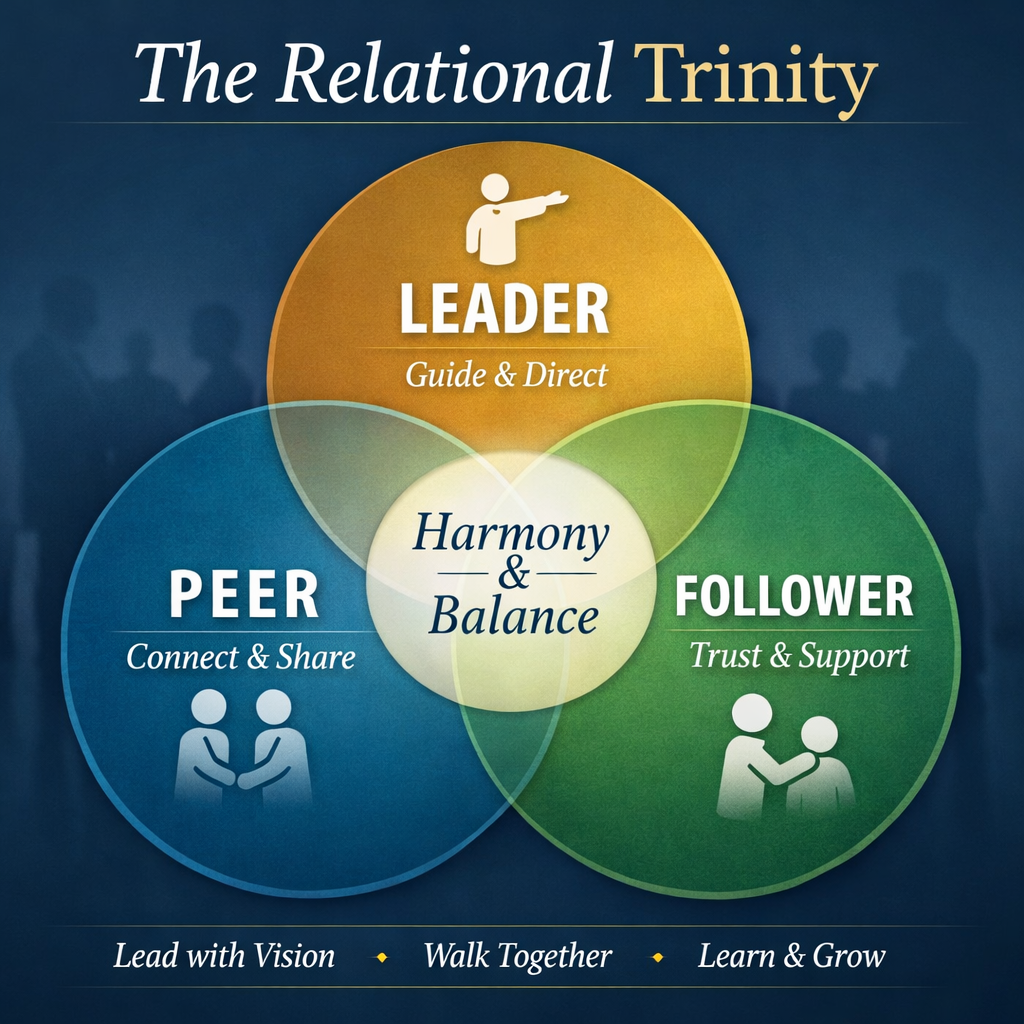
The Relational Trinity is a framework for understanding the three relational realms we inhabit: Leader, Peer, and Follower. Harmony in relationships isn’t about choosing one role; it’s about aligning the realms to create emotional safety and clarity.
1. The Three Relational Realms
- The Leader Realm (Direction & Structure): Focused on vision, decision-making, and guidance.
- Examples: Parents, CEOs, mentors.
- Core need: To provide boundaries and safety.
- The Peer Realm (Collaboration & Equality): The realm of “we,” where no one is above or below.
- Examples: Friends, siblings, co-workers.
- Core need: Shared experience and mutual respect.
- The Follower Realm (Trust & Teachability): The willingness to be guided and open to growth.
- Examples: Students, mentees, employees.
- Core need: Receptivity and humble execution.
2. The Source of Conflict: Misalignment
Tension usually arises from realm confusion rather than personality clashes.
- Competing Realms: Both people try to lead at once, causing power struggles.
- Misread Cues: One person seeks a Peer (empathy), but the other responds as a Leader (logic/solutions).
- The Marriage Exception: Marriage is unique because it requires fluid movement through all three realms daily—leading in finances, following in care, and operating as peers in leisure.
3. Modifiers: Why We Have a “Bent”
Our preference for a specific realm is shaped by upbringing, trauma, personality, and experience. These “modifiers” create our default setting (our “Bent”). Recognizing your bent helps you understand why some roles feel effortless while others feel draining.
4. Path to Relational Harmony
To improve your interactions, practice awareness through these three questions:
- What is my “Bent”? Do I naturally default to taking charge (Leader) or deferring (Follower)?
- Am I misreading the room? Does this moment require me to guide, to listen as an equal, or to trust someone else’s expertise?
- How do my “Modifiers” interfere? Does ego prevent me from following? Does fear prevent me from leading?
The Bottom Line: When we align our realms—matching a Leader with a Follower or a Peer with a Peer—relationships feel like a dance. Understanding these dynamics provides the language to navigate conflict with intention.
“Do nothing out of selfish ambition or conceit, but in humility consider others as more important than yourselves. Everyone should look not to his own interests, but rather to the interests of others.” – Philippians 2:3-4 (CSB)

 ThoughtPager