The Beauty of the Process

I don’t know about you, but I can be impatient at times. When I’m working toward something important, I often find myself wanting results before the process has had time to do its work. That impatience usually leads to frustration—and every time, I’m reminded that this is a mistake.

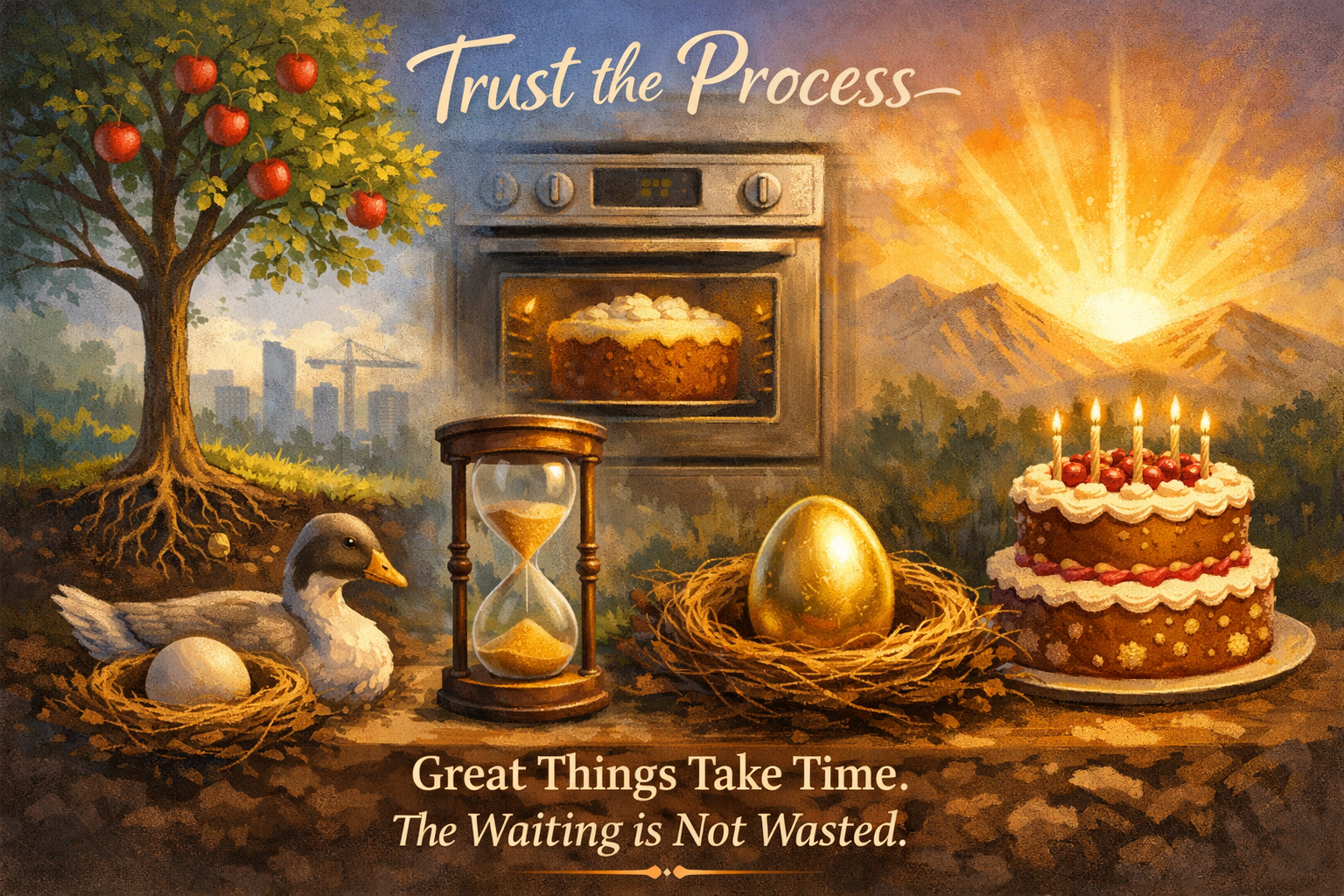
Before we can enjoy a delicious cake, we must give the ingredients time to bake. Before we can eat the fruit from a tree, we must first plant and nurture the seed—then wait as it germinates, grows, and finally bears fruit. Even before we can hold the golden egg, the goose must take time to lay it.

Everything worthwhile requires time. Food, automobiles, homes, and inventions all take a process far longer than ten seconds before they reach our hands. Yet in our age of instant gratification, we forget this basic truth: impatience can short-circuit progress.

Just as no chef can rush the oven without ruining the recipe, we can’t rush the growth phases in our own lives. Before I can handle the weight of larger projects, I must first endure the learning curves of smaller ones. Before I can lead with wisdom, I must first walk through seasons that test and refine my character.

The time it takes to reach a finished product always depends on its size or complexity. Masterpieces, whether they’re careers, relationships, or personal calling require layers of formation that only time can reveal. No wonder patience is called a virtue.

So instead of sabotaging the process with frustration, let’s rejoice in it. Because when the work is finally complete, the outcome will be far greater than we imagined. The waiting is not wasted. It’s preparation.

“Let perseverance finish its work so that you may be mature and complete, not lacking anything.” — James 1:4 (NIV)

The Quiet Work of Transformation

I’ve been working on my own transformation with more intention this year. Not the loud, dramatic kind—the kind that announces itself with fireworks and declarations—but the quieter, more honest kind. The kind that asks you to sit with yourself, confront your patterns, and choose differently even when the old ways feel easier.

And I’ll tell you the truth: change is hard. Not because we’re weak, but because we’re human.

Still, I’ve been leaning on a few voices that have helped me navigate the terrain with more clarity and courage.

Tony Robbins: Three Lenses That Reshape Reality

Tony Robbins offers a simple but profound framework—one that refuses to let us hide behind exaggeration or despair.

  • See the situation as it is, not worse than it is.
  • See the situation better than it is.
  • Make it the way you see it.

These three steps form a bridge—from honesty, to hope, to execution.

Chip and Dan Heath: The Anatomy of Change

In Switch, Chip and Dan Heath describe change as a three‑part negotiation between different parts of ourselves:

  • The logical side that wants clarity and direction.
  • The emotional side that wants meaning and motivation.
  • And the path itself, which must be simplified into the next small, doable step.

If any one of these is neglected, change stalls. If all three are aligned, change accelerates.

Where This Meets You

Maybe this resonates with you. Maybe you’re in your own season of becoming—stretching, shedding, reimagining. Or maybe you’re already standing in a place you once only dreamed of. If so, I celebrate that with you.

Either way, transformation is not a solitary pursuit. Someone you know is hungry for change, quietly wrestling with the same questions you’ve conquered or are currently confronting.

If this message speaks to you, pass it on. You never know whose life might shift because you shared a spark of insight at the right moment.

Transformation is possible.
Not easy.
Not instant.
But possible—and worth every step.

A Scriptural Anchor

“Being confident of this, that He who began a good work in you will carry it on to completion until the day of Christ Jesus.” —Philippians 1:6

This verse reminds us that transformation is a divine partnership. What begins in faith is sustained by grace—and God finishes what He starts.

Remember You

There’s a moment in every person’s life when they realize the biggest obstacle they’ve been fighting isn’t the world, the economy, their upbringing, or even the people around them. It’s the quiet, persistent lie they’ve been telling themselves for years.

And the wild part is this:
You can believe that lie so deeply, so fiercely, that you repeat the same mistake again and again—almost on autopilot. You defend it. You justify it. You wrap it in excuses and call it “just who I am.”

But pause for a second.
Ask yourself something bold and honest:

What exactly are you afraid of losing if you let that belief go?

Because beneath the fear, there’s a truth you already know:
Releasing that belief would make you better. Stronger. Lighter. More aligned with the person you’re trying to become.

So why hold on?

The Lie Feels Familiar—But Familiar Isn’t Freedom

We cling to limiting beliefs because they feel safe. Predictable. They give us a script to follow, even if it’s a script that keeps us small.

But familiarity is not the same as fulfillment.
Comfort is not the same as calling.

Every time you repeat that old story—
“I’m not good enough.”
“I always mess things up.”
“This is just how life is for me.”
“I can’t change.”

—you reinforce a version of yourself that no longer fits the life you’re trying to build.

Letting Go Isn’t Loss—It’s Liberation

Think about what you gain when you release the belief that’s been holding you hostage:

  • Clarity about who you really are
  • Courage to pursue what you’ve been avoiding
  • Confidence to step into new opportunities
  • Capacity to grow into the person your goals require

What you gain is far greater than anything you fear losing.

And the truth is, you’re not losing anything real.
You’re only losing the illusion that kept you from rising.

Remember Your Goals. Remember Your Dreams. Remember You.

Your goals weren’t given to the version of you who hides behind excuses.
Your dreams weren’t designed for the version of you who clings to old stories.
Your future isn’t waiting for the person you’ve been—it’s waiting for the person you’re becoming.

So today, choose to remember yourself.

Remember the you who once believed more was possible.
Remember the you who dared to imagine a bigger life.
Remember the you who refuses to settle for the lie any longer.

Change isn’t the enemy.
Change is the doorway.

And you’re standing right in front of it.

Step through.

You will know the truth, and the truth will set you free.
– John 8:32 (CSB)

Don’t Miss the View

Think about a trip you’ve been dreaming about for years—one of those journeys you’ve imagined down to the smallest detail. You’ve pictured the hotel, the food, the sounds of the streets, the colors of the markets. You’ve researched the culture, the hidden gems, the must‑try dishes. You’ve packed and repacked your luggage, making sure nothing essential is left behind.

By the time you reach the airport, you’re buzzing with anticipation. You arrive early, not because you have to, but because excitement won’t let you sit still at home. The flight is smooth, the service is excellent, and everything feels like confirmation that this trip was meant for you.

Then the plane lands. It taxis toward the terminal. Your heart beats a little faster. The doors open, and you step into the air of the destination you’ve been longing to experience. You inhale deeply… and suddenly you cover your eyes.

Your family and friends stare at you. “What are you doing? Don’t you want to see this new place?”

And you answer, “No… I’m too scared.”

Of course, they’d pull your hands away. They’d insist you look. They’d remind you that this is the moment you’ve been waiting for.

But isn’t this exactly what many of us do when change finally arrives? We dream, plan, hope, and pray for something new—yet when the door opens, we hesitate. We shield ourselves from the very thing we said we wanted.

Change Is the Destination You Manifested

Whether we realize it or not, change is often the arrival of the very things we’ve been manifesting. Our thoughts, beliefs, and desires shape our direction long before our feet ever move. What we focus on—positive or negative—eventually materializes in our lives.

So if the change in front of you doesn’t excite you, it may be worth asking: Have I been manifesting something uninspiring? Have my thoughts been aligned with what I want—or what I fear?

Your current reality is a reflection of what you’ve been rehearsing internally. And the beautiful part is that you can shift that rehearsal at any moment.

Focus Forward, Not Backward

Today, choose to focus on something you want—not what you don’t want. That single shift is a step toward it. Then stay consistent. Stay persistent. Keep moving in the direction of the life you’ve envisioned.

Because here’s the truth: To receive what you’ve been asking for, you must become the person who can hold it. Growth is not punishment—it’s preparation.

Don’t Fight the Change. Welcome It.

Change is not the enemy. It’s the doorway. It’s the jet bridge leading you into the world you’ve been imagining.

You don’t know what adventure, newness, fulfillment, joy, peace, or pleasure is waiting on the other side. But you’ll never find out if you keep your hands over your eyes.

So when life opens the door, step through it with courage. Look around. Take it in. Let the newness greet you.

Your destination is here. Don’t miss the view.

Reflect

“Look, I am about to do something new; even now it is coming. Do you not see it? Indeed, I will make a way in the wilderness, rivers in the desert.” – Isaiah 43:19 (CSB)

The Identity Beneath the Behavior

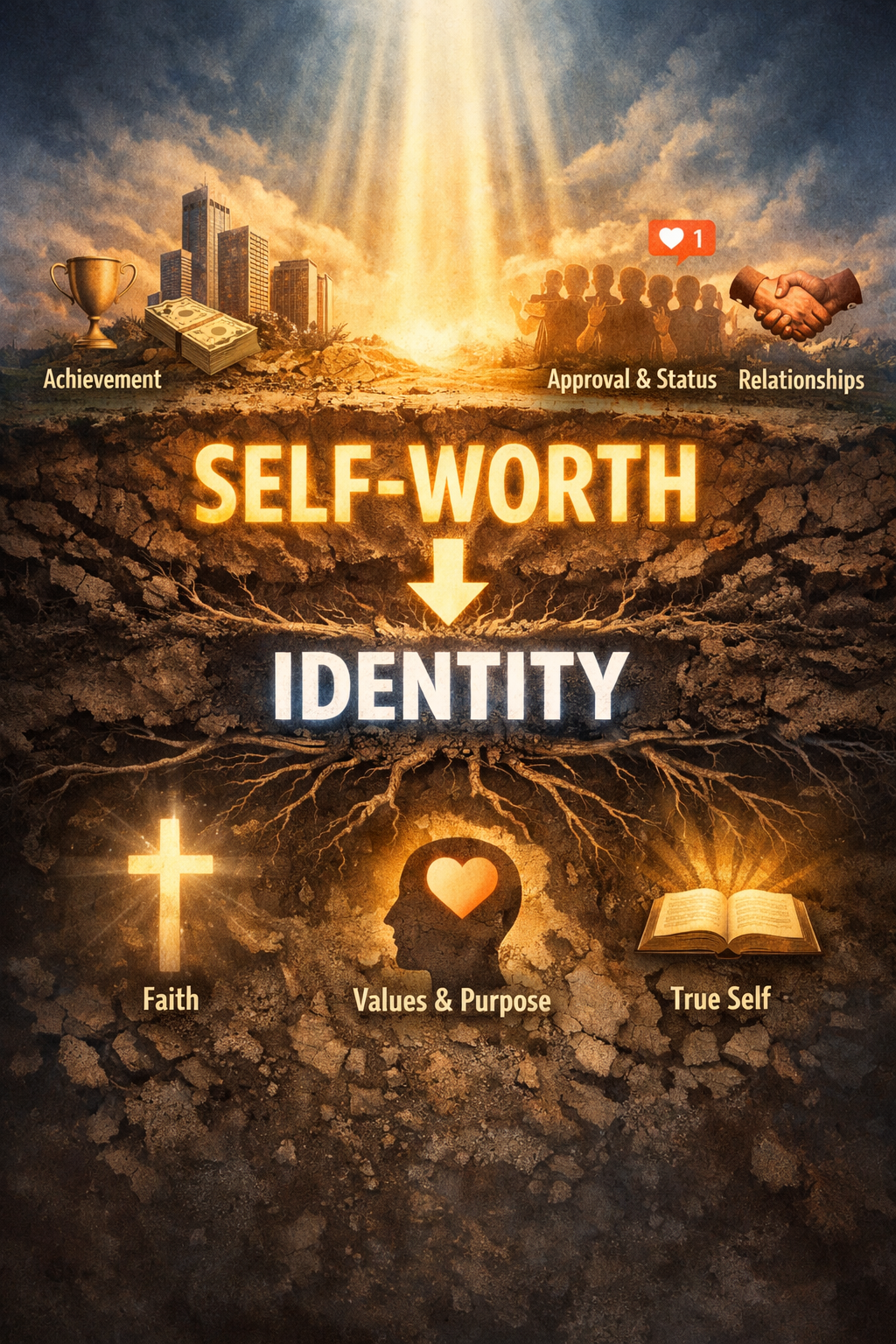
The way we define ourselves isn’t just a personal philosophy—it’s a blueprint that dictates our entire life’s output. If your self-concept is built on sand, your success will always feel like it’s sinking.

To go deeper, we can look to the teachings of T. Harv Eker, who argues that our internal “programming” is the invisible force behind our external reality.


The Invisible Blueprint: Who Is Running Your Life?

We often think our results come from our hard work alone. But Eker teaches a fundamental formula:

P → T → F → A = R

  • P (Programming): Leads to your…
  • T (Thoughts): Which lead to your…
  • F (Feelings): Which lead to your…
  • A (Actions): Which lead to your…
  • R (Results)

If you derive your sense of self from accomplishment, your programming might be set to a “High Achiever” frequency. While this drives results, Eker warns that if your motivation for success comes from a non-supportive root—like fear, anger, or the need to prove yourself—your accomplishments will never actually bring you peace. You are simply a “success” trying to fill a hole that only self-worth can plug.

1. The “Thermostat” of Self-Worth

Eker uses the analogy of a financial thermostat. If your self-concept is set to “I am a $50,000-a-year person,” and you suddenly make $100,000, you will likely find a way to “self-sabotage” back to your comfort zone.

The same applies to our identity. If you don’t believe you are worthy of respect or love without an achievement attached to it, you will subconsciously create conflict or stress to bring your reality back in line with your low internal “worth” setting.

2. When Identities Clash

When you interact with people who derive their identity from money or status, while you derive yours from achievement, you aren’t just speaking different languages—you’re operating on different “Wealth Files.”

Eker points out that “Rich people admire other rich and successful people,” whereas those with a scarcity mindset often resent success in others. If you find yourself in conflict with others, ask: “Am I reacting to them, or is my ‘programming’ being threatened by their ‘programming’?”

3. Rewiring the Self

To move forward, Eker suggests we must “observe” our thoughts rather than “be” our thoughts.

  • Awareness: Notice when you feel your worth is slipping because a goal wasn’t met.
  • Disassociation: Realize that this “need to achieve” is just a program you learned—it isn’t you.
  • Declaration: Re-anchor your identity in your innate value. As Eker says, “No amount of money can ever make you good enough… because you are already enough.”

Reflection

True mastery is being “bigger than your problems.” When your sense of self is grounded in your ability to handle whatever comes, rather than the specific outcome of the day, you become unstoppable.

“For in Him we live, and move, and have our being.” — Acts 17:28

BELIEFS

Every life is driven by something. Motivation and discipline get the credit, but beneath your habits, decisions, relationships, and direction lies something deeper:

Your beliefs.

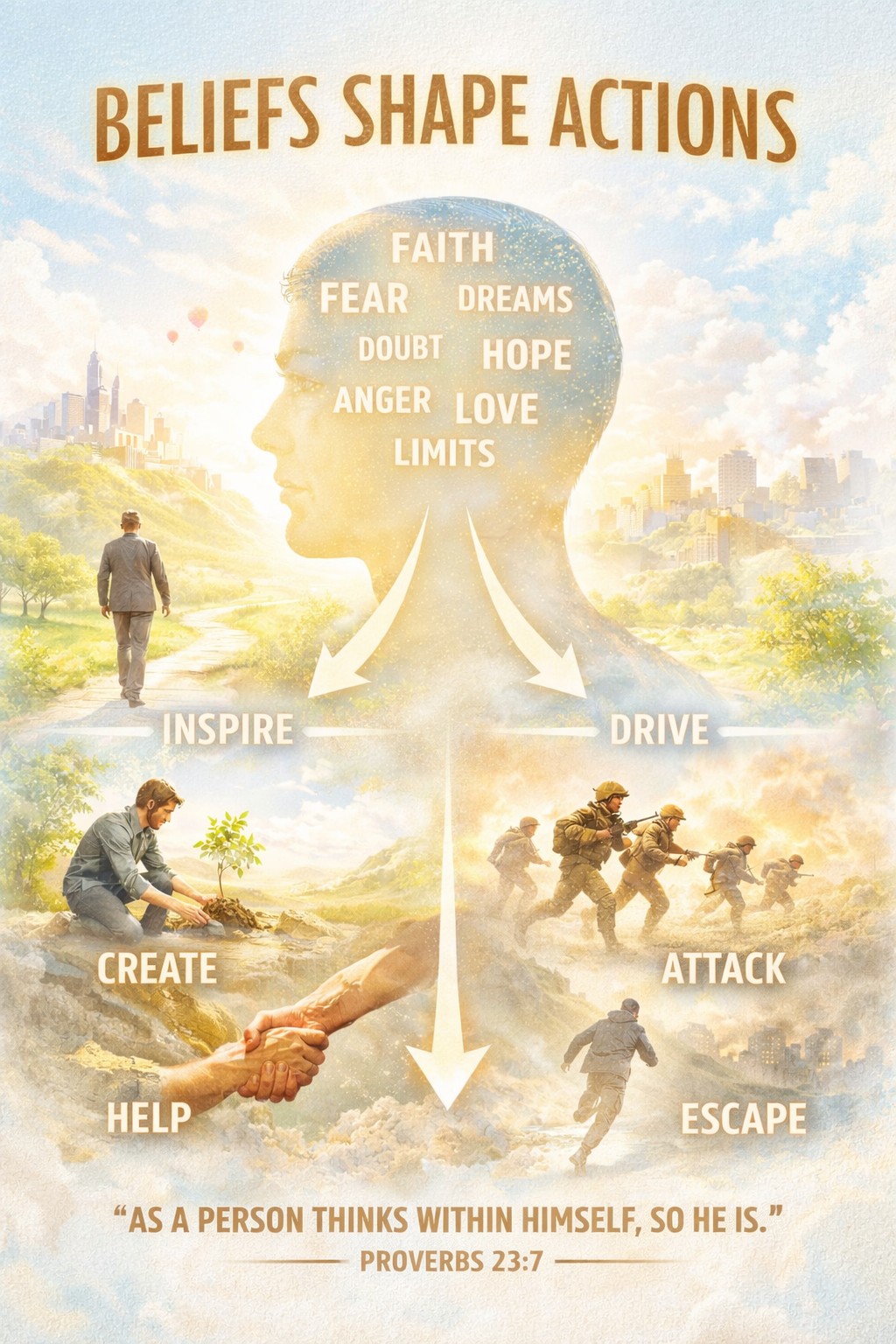
A thought is harmless until you adopt it as true. Once you do, it becomes a belief—and beliefs quietly shape the quality and trajectory of your life.

Belief Drives Behavior

Consider a publishing lesson.

J.K. Rowling’s first book launched in the U.K. as Harry Potter and the Philosopher’s Stone. When preparing it for the U.S., publishers believed American kids would find “philosopher” dull or academic. So they changed one word:

Harry Potter and the Sorcerer’s Stone.

Same story. Same magic. Different belief.

The result? Explosive success in the U.S.

Nothing changed but perception—and perception drove action.

We don’t act on what’s true.
We act on what we believe is true.

Belief Can Reshape History

Belief doesn’t just guide individuals—it moves nations.

In 1967, during the buildup to the Six-Day War, Egypt believed Israel was preparing to attack. Israel believed Egypt was mobilizing to strike first. Neither side had full confirmation. Both acted on belief.

Israel launched a preemptive strike. War followed. The region was reshaped—not by verified facts, but by perceived intent.

Belief can preserve peace or ignite conflict.

Belief Organizes Life

There’s an old song that says:

I believe God,
I believe God,
I believe God just as He said.

What you believe about God organizes everything else—your spiritual posture, mental framework, emotional responses, relationships, and decisions.

The same is true socially. Your beliefs about leadership, loyalty, communication, and trust shape how you show up at home, at work, and in your community. Two people can experience the same event and walk away with different conclusions—not because of the event, but because of the beliefs they brought with them.

Why We Hold On to Beliefs

We don’t cling to beliefs because they’re true. We cling to them because they’re familiar—or useful.

Whether we change often depends on:

  • who is asking us to change
  • how much we trust them
  • whether we believe the change is worth the cost

Advice from Jeff Bezos lands differently than advice from a stranger. A request from someone you love carries more weight than one from a coworker.

Belief is relational. Emotional. Contextual.

Where Beliefs Come From

Beliefs are shaped by upbringing, environment, influencers, trauma, success, fear, goals, and perceived limitations. They don’t appear out of nowhere—they’re formed over time.

And that’s the good news.

Beliefs can be examined.
Beliefs can be challenged.
Beliefs can be upgraded.

Choose Belief on Purpose

If beliefs shape destiny, they deserve intention.

Ask yourself:

  • Does this belief expand me or limit me?
  • Did I choose it—or inherit it?
  • Who would I become if I believed better?

Your life will rise—or fall—to the level of your beliefs.

Choose wisely.

“As a person thinks within himself, so he is.”
Proverbs 23:7, Christian Standard Bible (CSB)

Built To Be People Centered

The Clues Are in Our Instincts

Watch what happens when you connect with someone.

You don’t calculate a smile when you meet someone new—you just smile. You don’t plan laughter when a friend tells a great joke—it spills out. You don’t need instructions to hug your family—you lean in. These gestures aren’t taught. They’re instinctive.

And instincts reveal design.

They point to something profound about how we’re wired: we were built to be people-centered. Connection isn’t optional or learned later—it’s embedded. While modern culture nudges us toward self-focus and accumulation, the satisfaction it promises fades quickly. Compare that to the lasting lift you feel when you encourage someone or make another person’s day better. One disappears. The other compounds.

Zig Ziglar said it best: “You can have everything in life you want, if you will just help enough other people get what they want.” That’s not hype—it’s how life actually works.

Blessing Others Changes Us

Humans thrive when we lift others. Our mood improves. Our stress decreases. Our sense of purpose expands. Even our physical health responds positively to acts of kindness.

Service realigns us. Anxiety loosens. Gratitude grows. Joy shows up—not because we chased it, but because we stopped staring at ourselves long enough to serve someone else. Trust and opportunity tend to follow the same pattern, finding people who consistently add value.

Self-Care Fuels Other-Care

Being people-centered doesn’t mean neglecting yourself. You can’t pour from an empty cup.

Taking care of your body, finances, mental health, and spiritual life increases your capacity to bless others with consistency and generosity. Self-care isn’t the destination—it’s the fuel.

We were built to give, and Scripture reminds us why:

“Do not neglect to do what is good and to share, for God is pleased with such sacrifices.”
— Hebrews 13:16 (CSB)

Care for yourself wisely.
Bless others generously.
Joy tends to follow.

No Muscle

Just say no.”

It’s a phrase indelibly linked to public service campaigns—from Nancy Reagan’s stern warning against drug use to Michelle Obama’s encouragement to young people. It’s a simple, decisive command, and it aims at the big, life-altering decisions.

But I want to offer an insight: the true power of “no” isn’t reserved only for these momentous, life-or-death choices. Its most profound impact is felt in the daily, small decisions we face in our personal and professional lives. These are the choices we often dismiss as insignificant, yet they are the silent architects of our trajectory.

The Tyranny of the Small “Yes”

We are wired to be agreeable. To be team players. To be responsive—to texts, emails, requests for “just 15 minutes” of our time. We fear the awkward silence, the momentary disappointment, or the potential missed opportunity that a “no” might bring.

So, we say yes.

  • Yes, to the extra, non-essential task at work.
  • Yes, to the social engagement we dread.
  • Yes, to the distracting notification on our phone.
  • Yes, to the small detour that is miles off our personal road map.

Each “yes” on a small, non-essential item is a micro-withdrawal from our most precious accounts: time, energy, and focus. Individually, they feel harmless. But stacked up over weeks and months, these small “yeses” create a crushing weight. They dilute our effort, erode our momentum, and ultimately, can lead us down a catastrophic trajectory where we are busy but unproductive, exhausted but unfulfilled, and our brand—our identity and what we stand for—is blurred by a thousand compromises.

Your “No” Muscle: A Necessary Discipline

This is where the concept of the “No” Muscle comes in.

To say “no” when it truly matters—to a toxic influence, a professional over-commitment, or a habit that drains your soul—requires strength. And like any muscle, that strength must be developed through practice. If you haven’t built the discipline of declining the small, distracting, and non-essential things, you will have no strength—no muscle—to utter that decisive word when the stakes are high.

Practice makes stronger. Start today by recognizing that saying “no” to one thing is saying “yes” to another.

  • Saying no to an unnecessary meeting is saying yes to focused work.
  • Saying no to a distracting notification is saying yes to presence and clarity.
  • Saying no to a request that doesn’t align with your goals is saying yes to integrity and your own mission.

Build that muscle by starting small. Be selective about your time. Guard your energy as your most valuable asset. Recognize that your calendar is not a suggestion box; it is the ledger of your life, and you are the only one who can truly authorize the debits and credits.

The strength to say “no” is not rudeness; it is self-respect. It is not a denial of others; it is an affirmation of self. Start flexing that muscle today, and watch as your trajectory straightens, your energy reserves replenish, and your momentum becomes unstoppable.


A Word of Guidance

The internal discipline required to maintain a focused life is the true work of the heart. The Bible speaks to this vigilance:

“Above all else, guard your heart, for everything you do flows from it.”

(Proverbs 4:23, NIV)

This “guarding” is the active, continuous process of building your “No” Muscle—protecting the source of your thoughts, intentions, and actions from the countless small distractions that seek to drain its vitality.

Why We Sabotage What We Want Most

Understanding the hidden psychology behind self-sabotage and reclaiming your path to growth

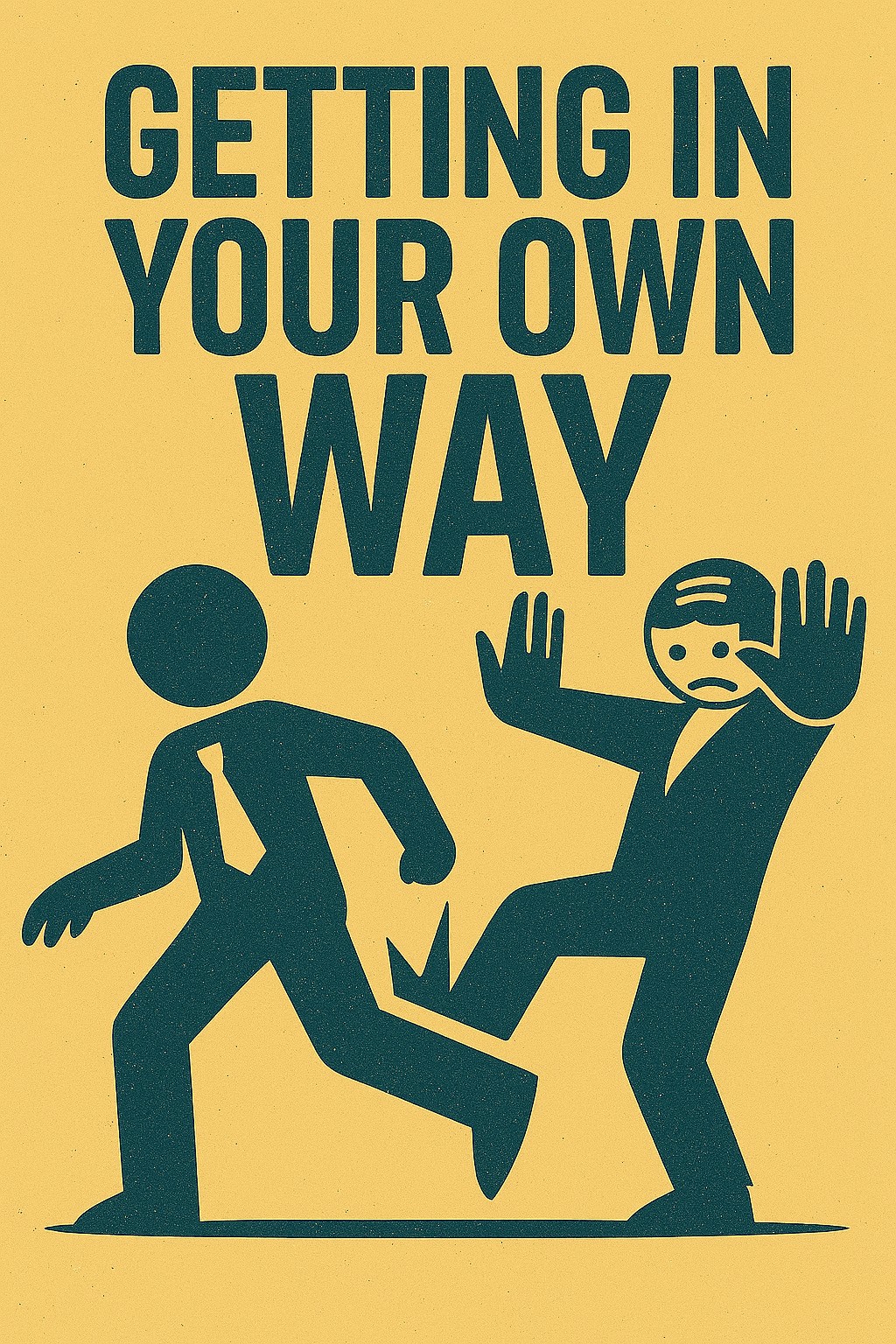
We’ve all been there—setting goals with clarity and conviction, only to find ourselves doing the very things that derail our progress. Whether it’s procrastinating, overspending, or avoiding the hard conversations, self-sabotage feels like a betrayal of our own intentions. But it’s not random. It’s a signal.

Here’s what’s really going on beneath the surface—and how to break the cycle.

1. Fear of Success and Change

Progress demands transformation. It asks us to shed old identities and step into new ones. But change—even good change—can feel threatening. Sabotage is often a way of clinging to the familiar.

2. Imposter Syndrome

When we don’t believe we’re worthy of the success we’re pursuing, we unconsciously act in ways that confirm that belief. It’s a self-fulfilling prophecy rooted in doubt.

3. Emotional Avoidance

Growth requires discomfort—discipline, vulnerability, effort. Sabotage is often a shortcut to avoid those feelings. It’s easier to scroll, spend, or distract than to face what’s hard.

4. Addiction to Immediate Gratification

Our brains are wired for dopamine. Quick hits of pleasure—junk food, impulse buys, social media—can override long-term goals. Sabotage often feels good in the moment, even if it costs us later.

5. Loyalty to Old Stories

Some of us carry generational or cultural narratives that glorify struggle. Sabotage can be a way of staying loyal to those stories, even when they no longer serve us.

🔄 How to Break the Pattern

  • Name the Emotion: Before you sabotage, pause. Ask: What am I feeling right now? What am I afraid of?
  • Reframe the Identity: Instead of “I always mess up,” try “I’m learning to show up differently.”
  • Create Rituals, Not Just Goals: Habits anchored in meaning are harder to sabotage.
  • Practice Compassion: Sabotage isn’t a sin—it’s a signal. Treat it with curiosity, not shame.

Self-sabotage isn’t proof of failure. It’s proof that something deeper needs healing. When you understand the roots, you can rewrite the story—and reclaim your progress.

“I do not understand what I do. For what I want to do I do not do, but what I hate I do.”

-Romans 7:15 (NIV)

Rewrite the Story

The mind is wired for stories—it’s how we make sense of the world. And like the spread on a lunch buffet, there’s something for every taste: adventure stories, victim stories, hero stories, cautionary tales, or comeback chronicles. We don’t just consume stories from books or Netflix; we absorb them from our homes, the media, our faith communities, and the workplace. But the most influential narratives are the ones we quietly repeat in our own minds.

We become what we believe, and often what we believe comes from the stories we’ve inherited—not necessarily the ones we’ve chosen. Maybe someone told you, “You’re too much,” or “You’re not enough.” Maybe you’ve internalized a story of scarcity, fear, or failure. Without realizing it, those old scripts can shape your present and limit your future.

Let’s name five common types of stories we live by:

  1. The Victim Story“Bad things always happen to me.”
  2. The Martyr Story“I have to sacrifice everything for others.”
  3. The Hero Story“I’ve overcome, and I’ll do it again.”
  4. The Underdog Story“No one believed in me, but I proved them wrong.”
  5. The Stuck Story“This is just the way things are. I can’t change.”

Which one have you been telling yourself? And is it even true?

Tony Robbins emphasizes three life-changing questions we can use to take back authorship of our own story:

  1. What are you going to focus on? – Because what you focus on, you feel.
  2. What does it mean? – You get to assign the meaning to your experiences.
  3. What are you going to do about it? – Change begins with action.

Today, choose one sentence you’ve been telling yourself—just one—and rewrite it.
Instead of: “I’m always behind.”
Try: “I am learning to move at the pace of grace.”

Instead of: “I’m not good enough.”
Try: “I am uniquely equipped to grow into who I’m called to be.”

God didn’t create you to live in bondage to a broken narrative. You’re not stuck with the first draft. You’re invited to co-author a better one—with Him.

“Do not be conformed to this age, but be transformed by the renewing of your mind, so that you may discern what is the good, pleasing, and perfect will of God.”
—Romans 12:2 (CSB)