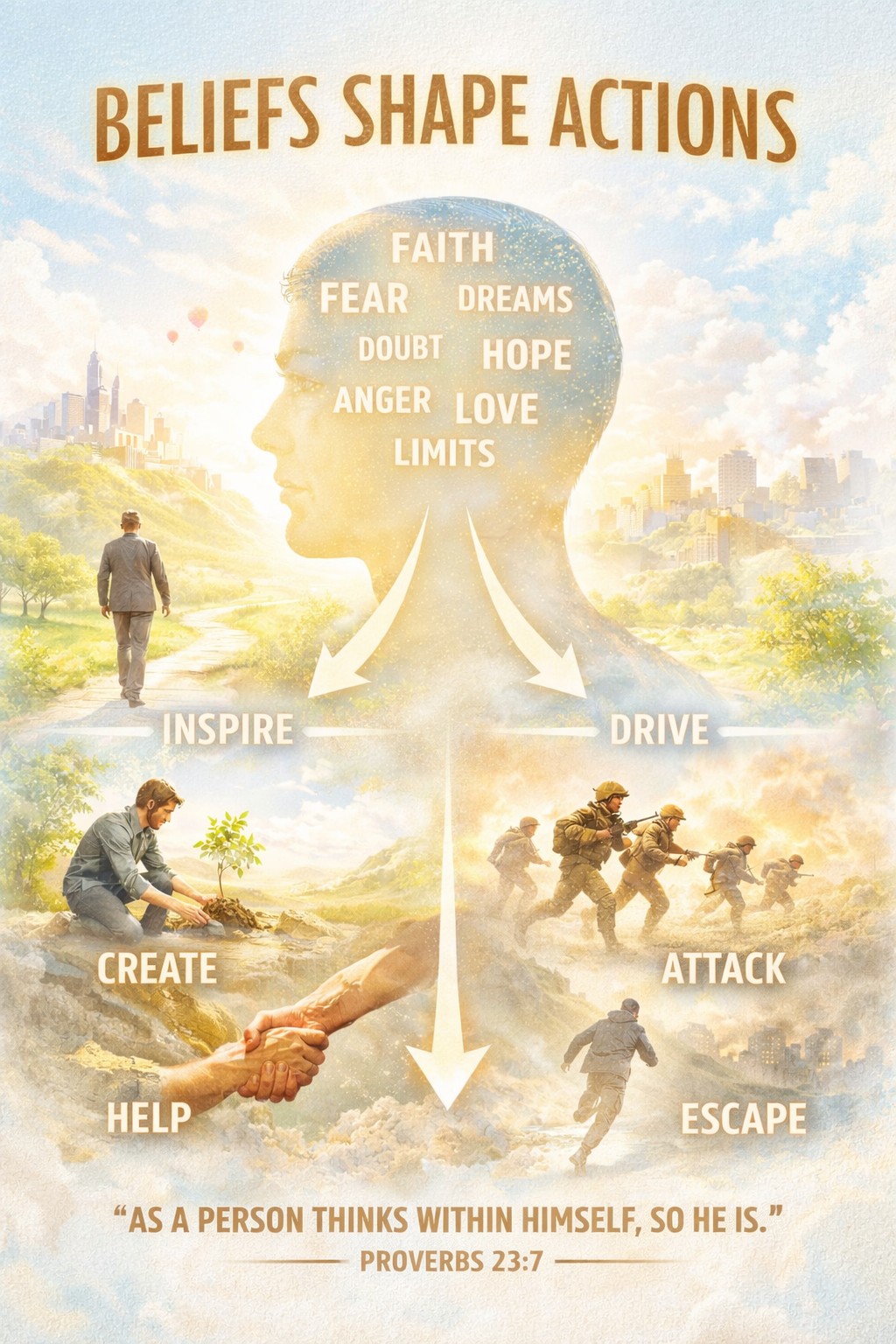
BELIEFS

Every life is driven by something. Motivation and discipline get the credit, but beneath your habits, decisions, relationships, and direction lies something deeper:

Your beliefs.

A thought is harmless until you adopt it as true. Once you do, it becomes a belief—and beliefs quietly shape the quality and trajectory of your life.

Belief Drives Behavior

Consider a publishing lesson.

J.K. Rowling’s first book launched in the U.K. as Harry Potter and the Philosopher’s Stone. When preparing it for the U.S., publishers believed American kids would find “philosopher” dull or academic. So they changed one word:

Harry Potter and the Sorcerer’s Stone.

Same story. Same magic. Different belief.

The result? Explosive success in the U.S.

Nothing changed but perception—and perception drove action.

We don’t act on what’s true.
We act on what we believe is true.

Belief Can Reshape History

Belief doesn’t just guide individuals—it moves nations.

In 1967, during the buildup to the Six-Day War, Egypt believed Israel was preparing to attack. Israel believed Egypt was mobilizing to strike first. Neither side had full confirmation. Both acted on belief.

Israel launched a preemptive strike. War followed. The region was reshaped—not by verified facts, but by perceived intent.

Belief can preserve peace or ignite conflict.

Belief Organizes Life

There’s an old song that says:

I believe God,
I believe God,
I believe God just as He said.

What you believe about God organizes everything else—your spiritual posture, mental framework, emotional responses, relationships, and decisions.

The same is true socially. Your beliefs about leadership, loyalty, communication, and trust shape how you show up at home, at work, and in your community. Two people can experience the same event and walk away with different conclusions—not because of the event, but because of the beliefs they brought with them.

Why We Hold On to Beliefs

We don’t cling to beliefs because they’re true. We cling to them because they’re familiar—or useful.

Whether we change often depends on:

  • who is asking us to change
  • how much we trust them
  • whether we believe the change is worth the cost

Advice from Jeff Bezos lands differently than advice from a stranger. A request from someone you love carries more weight than one from a coworker.

Belief is relational. Emotional. Contextual.

Where Beliefs Come From

Beliefs are shaped by upbringing, environment, influencers, trauma, success, fear, goals, and perceived limitations. They don’t appear out of nowhere—they’re formed over time.

And that’s the good news.

Beliefs can be examined.
Beliefs can be challenged.
Beliefs can be upgraded.

Choose Belief on Purpose

If beliefs shape destiny, they deserve intention.

Ask yourself:

  • Does this belief expand me or limit me?
  • Did I choose it—or inherit it?
  • Who would I become if I believed better?

Your life will rise—or fall—to the level of your beliefs.

Choose wisely.

“As a person thinks within himself, so he is.”
Proverbs 23:7, Christian Standard Bible (CSB)

I Must Work

There’s a phrase that has echoed through generations: “I must pray like it depends on God and work like it depends on me.” It captures a profound truth—faith and action are not opposites, but partners. Prayer aligns our hearts with God’s will, but work is the vessel through which His blessings flow.

The critical part of this truth is simple: we must DO something. Faith without works is incomplete. God multiplies effort, but He cannot multiply idleness. The more we step forward, the more He can use us. The more we desire or are entrusted with, the more responsibility we carry to act.

Consider the widow in 1 Kings 17. She had only a handful of flour and a little oil, yet she gave all she had to bake bread for the prophet Elijah. Her offering was small in quantity but enormous in effort and faith. The result? She was blessed with an abundance of oil and flour that sustained her household through famine. Her work, though humble, became the channel for God’s miracle.

Or think of the parable of the talents in Matthew 25. The servants were not praised for simply holding onto what they were given. They were expected to use their talents, to multiply them, to work diligently. The one who buried his talent was rebuked, while those who invested and earned more were rewarded. Notice that those entrusted with more talents carried greater responsibility. God’s expectation scales with His blessings.

The lesson is clear: work is not optional—it is essential. Prayer opens the door, but work walks through it. Effort is the seed, and God provides the harvest. When we act, even in small ways, we invite God to magnify our labor into something far greater than we could imagine.

So let us embrace the call: I must work. Not out of striving for self-glory, but out of obedience, stewardship, and faith. For in our labor, God’s power is revealed.

Scripture to reflect on:

“Whatever you do, work at it with all your heart, as working for the Lord, not for human masters.” — Colossians 3:23

Processing the Process

We all want the breakthrough without the breakdown. The progress without the process. But life, in its stubborn wisdom, doesn’t allow shortcuts. It requires us to walk through the very thing we’d rather skip.

The challenge is patience. Time is a teacher that refuses to be rushed. And when you’re in a season of recovery or growth, time feels like a treadmill set on “eternity mode.” Every step counts, but it seems like you’re not moving fast enough.

Here’s the real question: What am I recovering from, and what am I progressing toward?

The answer determines the length and intensity of the process. Some wounds heal quickly while others require layers of restoration. Some goals are sprints; others are marathons. Either way, rushing only leads to reinjury or burnout.

Take Steve Young’s story, for example. Long before he became a Hall of Fame quarterback, he spent years sitting on the bench behind Joe Montana. It would have been easy to get frustrated, to think he’d never get his shot. But instead, he worked tirelessly in practice—studying, refining, and preparing. The process was long, humbling, and sometimes painful. Yet when his moment finally came, he wasn’t just ready—he excelled. His Super Bowl victory and MVP awards were the fruit of years of unseen work.

That’s why it’s crucial not to get frustrated with the processing of the process. The delays, the repetitions, the slow unfolding—it’s all part of shaping you for what’s next. God isn’t simply fixing circumstances; He’s refining character.

So, when impatience whispers, “Hurry up,” remember that every slow moment has meaning. Healing has its own pace. Growth has its own rhythm. And both are preparing you for what you prayed for.

As Paul reminds us:

“Being confident of this, that he who began a good work in you will carry it on to completion until the day of Christ Jesus.” —Philippians 1:6 (CSB)

Life Is…

Finish this sentence: Life is…

Before I reveal how I completed that sentence, let’s take a moment to reflect. Bob Marley once said, “Life without music, I can’t cope.” For him, life was musical—something to be felt deeply, rhythmically, and soulfully.

Maybe you’ve heard or even lived by some of these perspectives:

  • Life is a pain.
  • Life is an adventure.
  • Life is a test.
  • Life is a game.
  • Life is worthwhile.
  • Life is a blessing.
  • Life is not worth living.
  • Life is worth living.
  • Life is worthless.

Each of these reflects the heart and the mindset of the one speaking. They speak to where someone is mentally, emotionally, or spiritually at a given moment. And let’s be honest—sometimes we’ve felt all of them in the same week!

But here’s my definition:

Life is a blessing.

Yes, it can feel like a test on Monday, a game on Tuesday, and a rollercoaster by Wednesday. But even in the chaos, I’ve learned that life is either preparing me, teaching me, or rewarding me. Every challenge becomes a classroom. Every joy, a celebration. Every detour, a divine rerouting. And every silence, a setup for something greater.

Seeing life as a blessing doesn’t mean we ignore pain or pretend trials don’t exist. It means we choose to believe that something good can come out of everything—even the mess.

So when life feels like a test, I remember it’s a blessing in disguise.
When it feels like a game, I’m learning strategy, patience, and how to bounce back.
When it feels like an adventure, I lean in and trust the Guide.

Life is a blessing because it constantly invites us to grow, reflect, and give thanks. Not because it’s easy—but because it’s meaningful.

📖 “Give thanks in everything; for this is God’s will for you in Christ Jesus.” — 1 Thessalonians 5:18 (Christian Standard Bible – CSB)

The Power of a Gift

Today, I want to talk about giving. Christmas is a season filled with lights, laughter, and gifts, but the greatest gift of all came over 2,000 years ago when God gave us His Son, Jesus Christ. Through Him, we receive salvation, grace, and eternal hope—a gift beyond anything we could imagine or deserve.

Let me share a story that echoes this theme of giving. In 1939, a man named Robert L. May—Bob—was going through a tough time. He was a widower, raising his little daughter, Barbara, who was grieving her mother’s loss. Bob didn’t have much to give that Christmas, but he had a gift inside him—a story.

To lift Barbara’s spirits, Bob created Rudolph the Red-Nosed Reindeer. What started as a simple, heartfelt gift to his child became something far greater. Rudolph’s story of an outcast finding his place resonated with millions. That small act of love not only blessed his daughter but brought Bob unexpected wealth and joy.

Bob’s story reminds us that giving—whether it’s a story, a prayer, or simply our time—can transform lives. This Christmas, let’s remember the ultimate gift God gave: His Son, who came into this world to redeem us.

John 3:16 sums it up perfectly:

“For God loved the world in this way: He gave his one and only Son, so that everyone who believes in him will not perish but have eternal life.” (CSB)

As we celebrate, let’s reflect His love by giving of ourselves—our kindness, our resources, and our faith. A simple act of giving, rooted in love, can change the world.

Merry Christmas, and may you carry the joy of Christ in your hearts all year long!

Facing Temptations

Ever notice how, just as you’re making real progress toward your goal, something shiny pops up, waving like it has a neon sign that reads: “Hey! Forget your plan and check this out!” And isn’t it always when your timing couldn’t be worse? That’s where Jesus’ example becomes a lifesaver—showing us that these distractions can be overcome. Sometimes, God allows us to face tempting moments, almost as if to say, “So, are you serious about this?” It’s not always convenient, but it is revealing.

Think about the story of Jesus being led into the wilderness by the Spirit. For 40 days, He fasts, running on zero calories and maximum faith—basically, He’s starving. Enter the devil, who suggests Jesus could just turn some stones into a baguette. It’s the ancient equivalent of an infomercial popping up right when you’re trying to focus. But Jesus counters with Scripture: “Man must not live on bread alone but on every word that comes from the mouth of God” (Deuteronomy 8:3). Translation: Bread is good, but the Word of God? Way more filling.

Next, the devil tries another classic: “If you’re so special, jump off the Temple—God’s angels will catch you!” Now, this is the equivalent of those social media dares you know you shouldn’t do. Jesus replies, “Do not test the Lord your God” (Deuteronomy 6:16). He’s not about to take unnecessary risks for the sake of show.

Finally, the devil offers the world—literal fame, power, wealth, the works—if Jesus will just bow down to him. And Jesus shuts it down faster than a canceled show: “Go away, Satan! For it is written: ‘Worship the Lord your God, and serve only Him’” (Deuteronomy 6:13).

After this, the devil leaves, and angels come to comfort Jesus. This epic showdown serves as a reminder of the strength that comes from trusting God over what’s convenient. It’s proof that even when you’re hangry, lonely, or tempted by the world’s “shiny things,” God’s guidance can keep you on course. And in those weakest moments, we’re reminded of the power of faith and Scripture to help us dodge life’s distractions and stay focused on what truly matters.