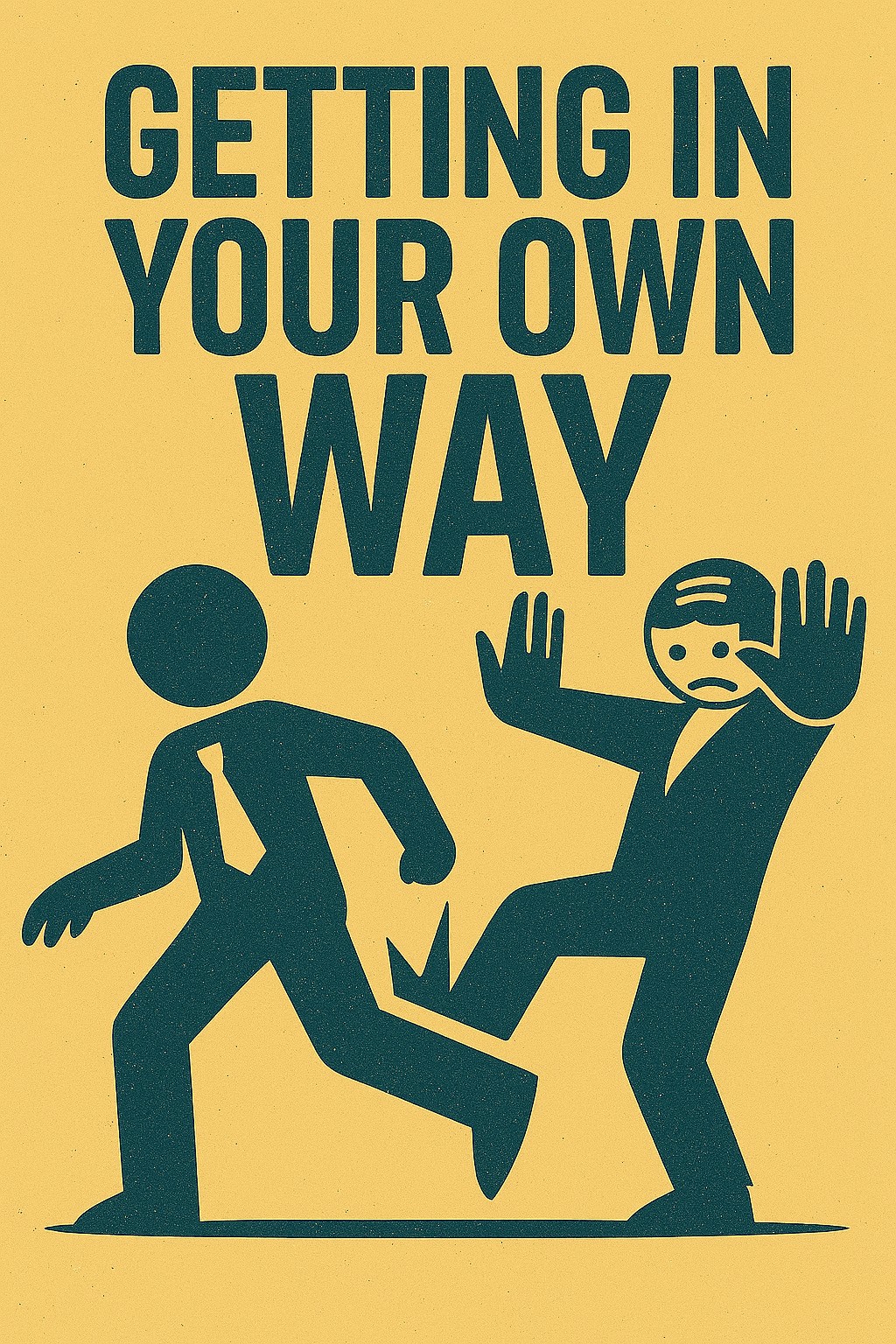
Why We Sabotage What We Want Most

Understanding the hidden psychology behind self-sabotage and reclaiming your path to growth

We’ve all been there—setting goals with clarity and conviction, only to find ourselves doing the very things that derail our progress. Whether it’s procrastinating, overspending, or avoiding the hard conversations, self-sabotage feels like a betrayal of our own intentions. But it’s not random. It’s a signal.

Here’s what’s really going on beneath the surface—and how to break the cycle.

1. Fear of Success and Change

Progress demands transformation. It asks us to shed old identities and step into new ones. But change—even good change—can feel threatening. Sabotage is often a way of clinging to the familiar.

2. Imposter Syndrome

When we don’t believe we’re worthy of the success we’re pursuing, we unconsciously act in ways that confirm that belief. It’s a self-fulfilling prophecy rooted in doubt.

3. Emotional Avoidance

Growth requires discomfort—discipline, vulnerability, effort. Sabotage is often a shortcut to avoid those feelings. It’s easier to scroll, spend, or distract than to face what’s hard.

4. Addiction to Immediate Gratification

Our brains are wired for dopamine. Quick hits of pleasure—junk food, impulse buys, social media—can override long-term goals. Sabotage often feels good in the moment, even if it costs us later.

5. Loyalty to Old Stories

Some of us carry generational or cultural narratives that glorify struggle. Sabotage can be a way of staying loyal to those stories, even when they no longer serve us.

🔄 How to Break the Pattern

  • Name the Emotion: Before you sabotage, pause. Ask: What am I feeling right now? What am I afraid of?
  • Reframe the Identity: Instead of “I always mess up,” try “I’m learning to show up differently.”
  • Create Rituals, Not Just Goals: Habits anchored in meaning are harder to sabotage.
  • Practice Compassion: Sabotage isn’t a sin—it’s a signal. Treat it with curiosity, not shame.

Self-sabotage isn’t proof of failure. It’s proof that something deeper needs healing. When you understand the roots, you can rewrite the story—and reclaim your progress.

“I do not understand what I do. For what I want to do I do not do, but what I hate I do.”

-Romans 7:15 (NIV)

Your Best for No Regrets

We’ve all been there: standing on the edge of a decision, feeling the pull to play it safe. We tell ourselves it’s a form of self-preservation, a way to avoid the sting of failure. But that path leads to a far greater pain: regret.

Giving your best isn’t just about the outcome; it’s about making a fundamental choice to leave nothing on the table. It’s a commitment to your full potential.

Our brains are wired to avoid pain. We fear the pain of trying and failing more than the slow, corrosive pain of not trying at all—until it’s too late. Regret is the psychological tax we pay for playing it safe. It’s the emotional toll of knowing we had more to give and held back. The pain of a temporary setback can become a stepping stone for growth; the pain of “what if?” is a permanent burden that erodes the spirit.

We’re Built for More

Human beings are designed with far more capacity than we realize. Most of us cruise at 40–60% of what we can actually handle. Our bodies and minds are wired to conserve energy, but that instinct works against us when it comes to pursuing greatness.

Take David Goggins, for example. He’s an ultra-marathon runner, Navy SEAL, and author who openly admits he wasn’t born with superhuman genetics. What set him apart was his refusal to settle for less than his all. He discovered what he calls the 40% rule: when you think you’re done, you’re usually only 40% done. There’s another 60% sitting untapped, waiting for you to reach for it.

Goggins’ story proves that giving your best isn’t about talent—it’s about mindset. It’s about refusing to accept the comfort zone as your ceiling. He understood that our minds give up long before our bodies do. By pushing past self-imposed limits, he found an unshakable peace that comes from knowing he gave everything he had.

What It Means for You

This isn’t abstract philosophy; it’s a profound behavioral principle. We are wired for progress, for challenges, for expansion. Our brains are incredibly plastic, and our bodies are far more capable than we give them credit for. The limiting beliefs we hold about ourselves are mostly a construct of fear. We set artificial boundaries because it feels safer than exploring our true limits.

So, what does this mean for you? “Giving your best” is your strategy for a life free of regret. It’s a conscious decision to choose the temporary discomfort of effort over the long-term ache of inaction. You have more in your tank than you think. The only way to find it is to give your all.

Start small. The next time you face a challenge, commit to giving it your absolute best effort. Don’t obsess over the outcome; focus on the effort. When you’re done, you’ll have something more valuable than any victory: the peace of mind that comes from knowing you did everything you could.

That, my friends, is worth more than gold.

“Whatever you do, do it from the heart, as something done for the Lord and not for people.” — Colossians 3:23 (CSB)

Intentional Action

Humans communicate, accomplish, and advance by design. We express intentions through action. At a social gathering, we extend a hand and offer a smile. We don’t wait for others to guess our warmth—we show it. We don’t hope people understand us—we reveal ourselves.

When we face an exam, we study. We review notes. We solve problems. We prepare. We don’t rely on potential—we prove our knowledge through effort. When we aim to become better speakers, we practice. We deliver speeches. We observe great communicators. We don’t just wish for improvement—we earn it.

We move forward only when we act. We don’t drift toward goals—we steer toward them. We don’t stumble into growth—we build it.

🧭 Columbus: A Man Who Moved

Christopher Columbus didn’t discover new lands by standing still. He sailed. He persuaded monarchs. He assembled crews. He launched ships. He endured storms. He navigated uncertainty. He didn’t wait for perfect conditions—he created opportunity through motion.

Columbus didn’t reach Asia, but he reached the Caribbean. He didn’t fulfill his original plan, but he changed history. He acted with intention. He moved with purpose. He didn’t theorize—he explored.

His ships—the Niña, the Pinta, and the Santa María—didn’t symbolize dreams. They embodied action. They didn’t drift—they cut through oceans. Columbus didn’t wait for the world to change—he changed it by moving.

🔥 Movement Builds Meaning

We don’t achieve by thinking alone—we achieve by doing. We don’t grow by hoping—we grow by working. We don’t transform by imagining—we transform by engaging.

We must act. We must move. We must perform. Every step we take brings us closer to our destination. Every effort we make shapes our future.

Let us raise our sails. Let us leave the shore. Let us move toward the horizon.

“But be doers of the word and not hearers only, deceiving yourselves.”
—James 1:22 (CSB)

4 Quarters

The Comeback Story

It was a chilly December evening, and the stadium was packed with fans, their breath visible in the cold air. The New England Patriots were facing the Atlanta Falcons in Super Bowl LI. By the end of the third quarter, the Patriots were down 28-9. The odds seemed insurmountable, and many had already written them off. But in the fourth quarter, something incredible happened. Tom Brady, with his unyielding determination, led the Patriots to score 19 points, tying the game and forcing it into overtime. The Patriots went on to win 34-28, completing one of the greatest comebacks in NFL history.

The Metaphor: A Day In 4 Quarters

Just like a football game, our day can be divided into four quarters. Each quarter represents a part of our day: morning, late morning, afternoon, and evening. Often, we judge our entire day based on how the first few quarters go. If the morning starts off rough, we might feel like the whole day is doomed. If the late morning and afternoon don’t go as planned, we might be tempted to give up, thinking the day is a lost cause.

The Fourth Quarter: A Chance to Win

But just like the Patriots in Super Bowl LI, we have a fourth quarter. No matter how the first three quarters of our day have gone, the fourth quarter is an opportunity to turn things around. It’s a chance to persist, to push through, and to make the most of the time we have left. The fourth quarter is a reminder that it’s never too late to make a comeback.

That project you’ve been putting off? You can start it in the fourth quarter. That relationship you’ve neglected? You can send the text or make the call in the fourth quarter. That workout you skipped this morning? You can still move your body before bed.

Champions aren’t just defined by how they start—they’re remembered for how they finish.

Don’t write off the day. Don’t bench yourself when there’s still game left to play. Dig deep. Adjust your strategy. Persist. Win your fourth quarter.

Persist and Win

Life is full of challenges and setbacks, but it’s also full of opportunities for comebacks. When we find ourselves down and out, we can look to the fourth quarter as a time to regroup, refocus, and push forward with renewed determination. Remember, it’s not over until it’s over. Keep fighting, keep believing, and keep pushing forward.

Scripture for Encouragement

“Let us not get tired of doing good, for we will reap at the proper time if we don’t give up.”

—Galatians 6:9 (CSB)

Let’s embrace the fourth quarter with the same determination and hope, knowing that we have the power to turn things around and finish strong.

Your Unique Path

Have you ever noticed how your journey seems different from everyone else’s? While some sail smoothly on highways, you may feel like you’re trekking a winding mountain trail. And sometimes, that difference sparks admiration… or irritation… or even envy.

But here’s the truth: your path is not supposed to look like theirs. It’s designed for you. Your mission, destiny, personality, and life experiences shape the route you’re meant to take.

Think about it: Jesus’ mission was salvation for the world—His path was the cross. A doctor’s mission is to heal, and their path is years of medical school and residency, sometimes over a decade of intense preparation.

Every worthwhile path has its challenges. The question isn’t whether someone else’s journey looks easier or more glamorous. The real question is: are you willing to walk the road they had to walk to reach their success?

Instead of envy, let’s choose admiration. Instead of comparison, let’s choose respect. And instead of resentment, let’s choose celebration.

Because the best way to honor your own path is to walk it with focus, faith, and perseverance—knowing it was created with you in mind.

“Let us run with endurance the race that lies before us, keeping our eyes on Jesus, the pioneer and perfecter of our faith.” — Hebrews 12:1–2 (CSB)

Processing the Process

We all want the breakthrough without the breakdown. The progress without the process. But life, in its stubborn wisdom, doesn’t allow shortcuts. It requires us to walk through the very thing we’d rather skip.

The challenge is patience. Time is a teacher that refuses to be rushed. And when you’re in a season of recovery or growth, time feels like a treadmill set on “eternity mode.” Every step counts, but it seems like you’re not moving fast enough.

Here’s the real question: What am I recovering from, and what am I progressing toward?

The answer determines the length and intensity of the process. Some wounds heal quickly while others require layers of restoration. Some goals are sprints; others are marathons. Either way, rushing only leads to reinjury or burnout.

Take Steve Young’s story, for example. Long before he became a Hall of Fame quarterback, he spent years sitting on the bench behind Joe Montana. It would have been easy to get frustrated, to think he’d never get his shot. But instead, he worked tirelessly in practice—studying, refining, and preparing. The process was long, humbling, and sometimes painful. Yet when his moment finally came, he wasn’t just ready—he excelled. His Super Bowl victory and MVP awards were the fruit of years of unseen work.

That’s why it’s crucial not to get frustrated with the processing of the process. The delays, the repetitions, the slow unfolding—it’s all part of shaping you for what’s next. God isn’t simply fixing circumstances; He’s refining character.

So, when impatience whispers, “Hurry up,” remember that every slow moment has meaning. Healing has its own pace. Growth has its own rhythm. And both are preparing you for what you prayed for.

As Paul reminds us:

“Being confident of this, that he who began a good work in you will carry it on to completion until the day of Christ Jesus.” —Philippians 1:6 (CSB)

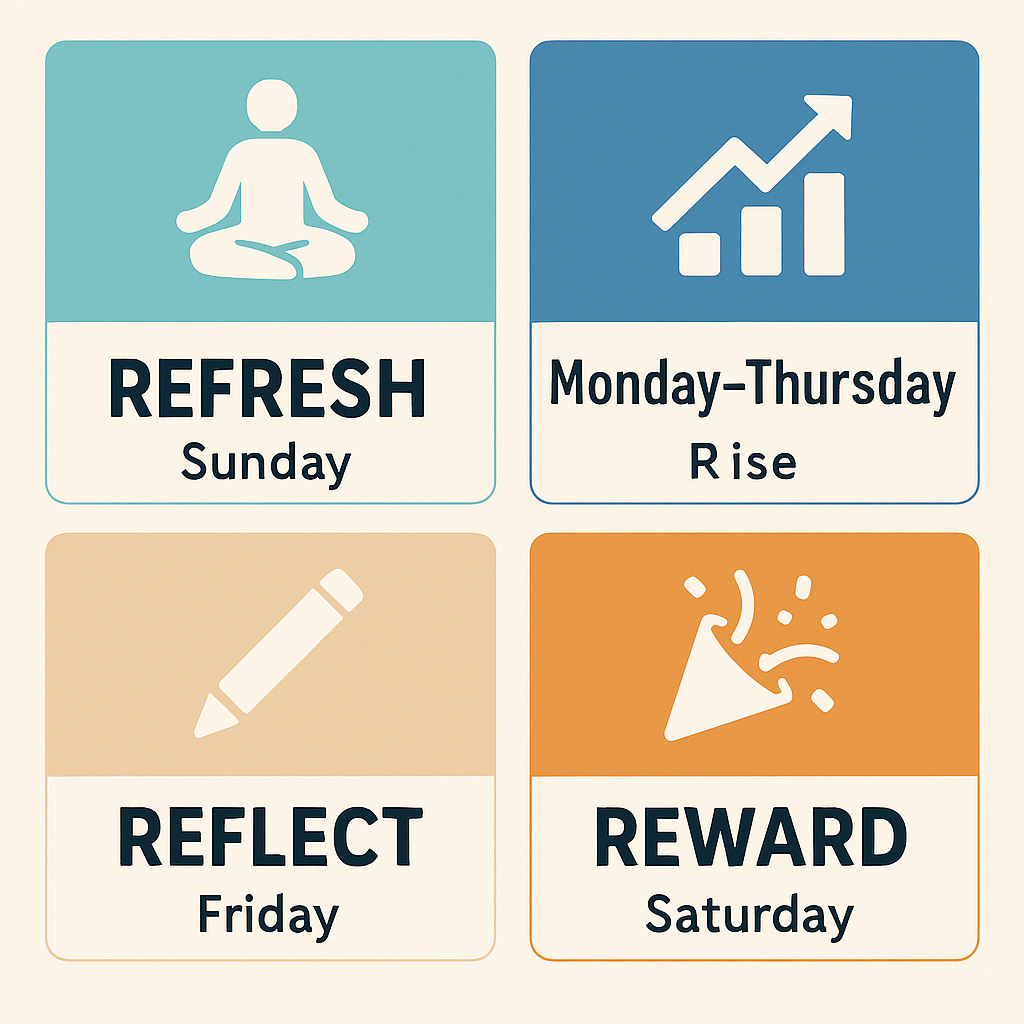
The 4 R’s That Shape My Week

The 4 R’s That Shape My Week

For years, I thought progress—whether in marriage, personal growth, or work—required daily consistency. If it wasn’t happening every single day, I felt like I was falling short. But life’s schedule had other ideas.

The turning point came during a marriage planning exercise. My original plan was to connect with my spouse daily, but our calendars didn’t agree. Rather than forcing what wasn’t working, we shifted our sessions to Sundays—and it worked beautifully. That one change revealed something bigger: I already had a natural weekly flow.

Daily Foundation: The 3 Cs
Every morning, I start with a routine I call the 3 Cs:

  1. Center – Water, writing, and Bible reading, along with prayer and exercise, to ground my mind and spirit.
  2. Consume – Fuel my body with something light to energize for the day ahead.
  3. Conquer – Launch into a mindset ready to win the day, tackling tasks with focus and intention.

This daily foundation sets the tone for the week and supports each of the 4 R’s.

Here’s how my weekly rhythm looks:

Sunday – Refresh (Marriage & Myself) 🧘 Sunday is sacred for renewal. It’s when I attend church, intentionally connect with my spouse, and carve out time for my own restoration—whether that’s reading, or simply quiet moments. This day is about refilling my cup so I can pour into the week ahead.

Monday–Thursday – Rise (Productivity & Progress) 📈 These are my “go” days. Fueled by Sunday’s reset, I commit to moving projects forward, tackling work goals, and leaning into growth. Momentum happens here—personally, professionally, and relationally. These are the days I intentionally rise to the challenge.

Friday – Reflect (Pause & Take Stock) ✍️ Friday is for intentional assessment. It’s my chance to look back—what went well, what needs growth, where I need to give thanks. Sometimes that’s journaling, sometimes it’s a walk or a good conversation. Reflection clears the way for Saturday.

Saturday – Reward (Celebrate the Wins) 🎉 By Saturday, it’s time to enjoy the fruit of the week—whether that’s a date night, a favorite meal, or simply something fun. Reward keeps the joy alive and marks a healthy close to the week. It’s a purposeful celebration.


Riding the Wave

What I’ve learned is this: daily checklists can feel rigid, but weekly rhythms flex with life’s realities—work, appointments, shifting energy, and the unexpected. Instead of fighting the tide, I’ve learned to ride the wave.

Your rhythm doesn’t need to look like mine. The point is not perfection but sustainability: creating a cadence that allows you to refresh, rise, reflect, and reward in ways that bring balance and growth.

“There is a time for everything, and a season for every activity under the heavens.” — Ecclesiastes 3:1 (CSB)

Aligned Perception

Ray Charles, the legendary musician whose soulful voice and piano mastery transcended generations, was not born blind. As a child, he loved the piano so much that the moment he heard his neighbor, Wylie Pitman, playing, he would rush over just to listen. Even before he could properly play, he would bang his hands on the keys in delight. Pitman, seeing the spark in the boy’s heart, began to teach him the basics.

Ray eventually lost his sight—initially thought to be a psychological condition, later diagnosed as glaucoma. Yet, blindness did not blind his ambition. Though he could not see, he could hear. And through hearing, he built melodies that moved millions. His eyes were closed, but his vision was open.

This leads us to a deeper truth about perception. If you look at the world through blue lenses, you will see blue—no matter how many voices insist it is red. Similarly, in life, there are moments when what we see and what we hear do not match. Psychologists call this “audiovisual incongruence.” In human experience, it manifests as confusion, indecision, and inconsistency. We cannot walk a straight path when our eyes and ears tell conflicting stories.

But here’s the real challenge: You don’t perceive the world as it is—you perceive it as you are. Our biases, wounds, and beliefs tint the lenses through which we see and filter the sounds we hear. If the lenses are bitter, the world will look bitter; if the soundtrack in our minds is fearful, the world will sound threatening.

So if we wish to experience the world as a better place, we must first become better people. We must align what we see with what we hear, rooting both in truth, humility, and love. Only then will our perception match reality, and only then will we walk with consistency of vision and clarity of direction.

“The eye is the lamp of the body. If your eye is healthy, your whole body will be full of light.”
Matthew 6:22, CSB

Life Is…

Finish this sentence: Life is…

Before I reveal how I completed that sentence, let’s take a moment to reflect. Bob Marley once said, “Life without music, I can’t cope.” For him, life was musical—something to be felt deeply, rhythmically, and soulfully.

Maybe you’ve heard or even lived by some of these perspectives:

  • Life is a pain.
  • Life is an adventure.
  • Life is a test.
  • Life is a game.
  • Life is worthwhile.
  • Life is a blessing.
  • Life is not worth living.
  • Life is worth living.
  • Life is worthless.

Each of these reflects the heart and the mindset of the one speaking. They speak to where someone is mentally, emotionally, or spiritually at a given moment. And let’s be honest—sometimes we’ve felt all of them in the same week!

But here’s my definition:

Life is a blessing.

Yes, it can feel like a test on Monday, a game on Tuesday, and a rollercoaster by Wednesday. But even in the chaos, I’ve learned that life is either preparing me, teaching me, or rewarding me. Every challenge becomes a classroom. Every joy, a celebration. Every detour, a divine rerouting. And every silence, a setup for something greater.

Seeing life as a blessing doesn’t mean we ignore pain or pretend trials don’t exist. It means we choose to believe that something good can come out of everything—even the mess.

So when life feels like a test, I remember it’s a blessing in disguise.
When it feels like a game, I’m learning strategy, patience, and how to bounce back.
When it feels like an adventure, I lean in and trust the Guide.

Life is a blessing because it constantly invites us to grow, reflect, and give thanks. Not because it’s easy—but because it’s meaningful.

📖 “Give thanks in everything; for this is God’s will for you in Christ Jesus.” — 1 Thessalonians 5:18 (Christian Standard Bible – CSB)

Rewrite the Story

The mind is wired for stories—it’s how we make sense of the world. And like the spread on a lunch buffet, there’s something for every taste: adventure stories, victim stories, hero stories, cautionary tales, or comeback chronicles. We don’t just consume stories from books or Netflix; we absorb them from our homes, the media, our faith communities, and the workplace. But the most influential narratives are the ones we quietly repeat in our own minds.

We become what we believe, and often what we believe comes from the stories we’ve inherited—not necessarily the ones we’ve chosen. Maybe someone told you, “You’re too much,” or “You’re not enough.” Maybe you’ve internalized a story of scarcity, fear, or failure. Without realizing it, those old scripts can shape your present and limit your future.

Let’s name five common types of stories we live by:

  1. The Victim Story“Bad things always happen to me.”
  2. The Martyr Story“I have to sacrifice everything for others.”
  3. The Hero Story“I’ve overcome, and I’ll do it again.”
  4. The Underdog Story“No one believed in me, but I proved them wrong.”
  5. The Stuck Story“This is just the way things are. I can’t change.”

Which one have you been telling yourself? And is it even true?

Tony Robbins emphasizes three life-changing questions we can use to take back authorship of our own story:

  1. What are you going to focus on? – Because what you focus on, you feel.
  2. What does it mean? – You get to assign the meaning to your experiences.
  3. What are you going to do about it? – Change begins with action.

Today, choose one sentence you’ve been telling yourself—just one—and rewrite it.
Instead of: “I’m always behind.”
Try: “I am learning to move at the pace of grace.”

Instead of: “I’m not good enough.”
Try: “I am uniquely equipped to grow into who I’m called to be.”

God didn’t create you to live in bondage to a broken narrative. You’re not stuck with the first draft. You’re invited to co-author a better one—with Him.

“Do not be conformed to this age, but be transformed by the renewing of your mind, so that you may discern what is the good, pleasing, and perfect will of God.”
—Romans 12:2 (CSB)