The Beauty of the Process

I don’t know about you, but I can be impatient at times. When I’m working toward something important, I often find myself wanting results before the process has had time to do its work. That impatience usually leads to frustration—and every time, I’m reminded that this is a mistake.

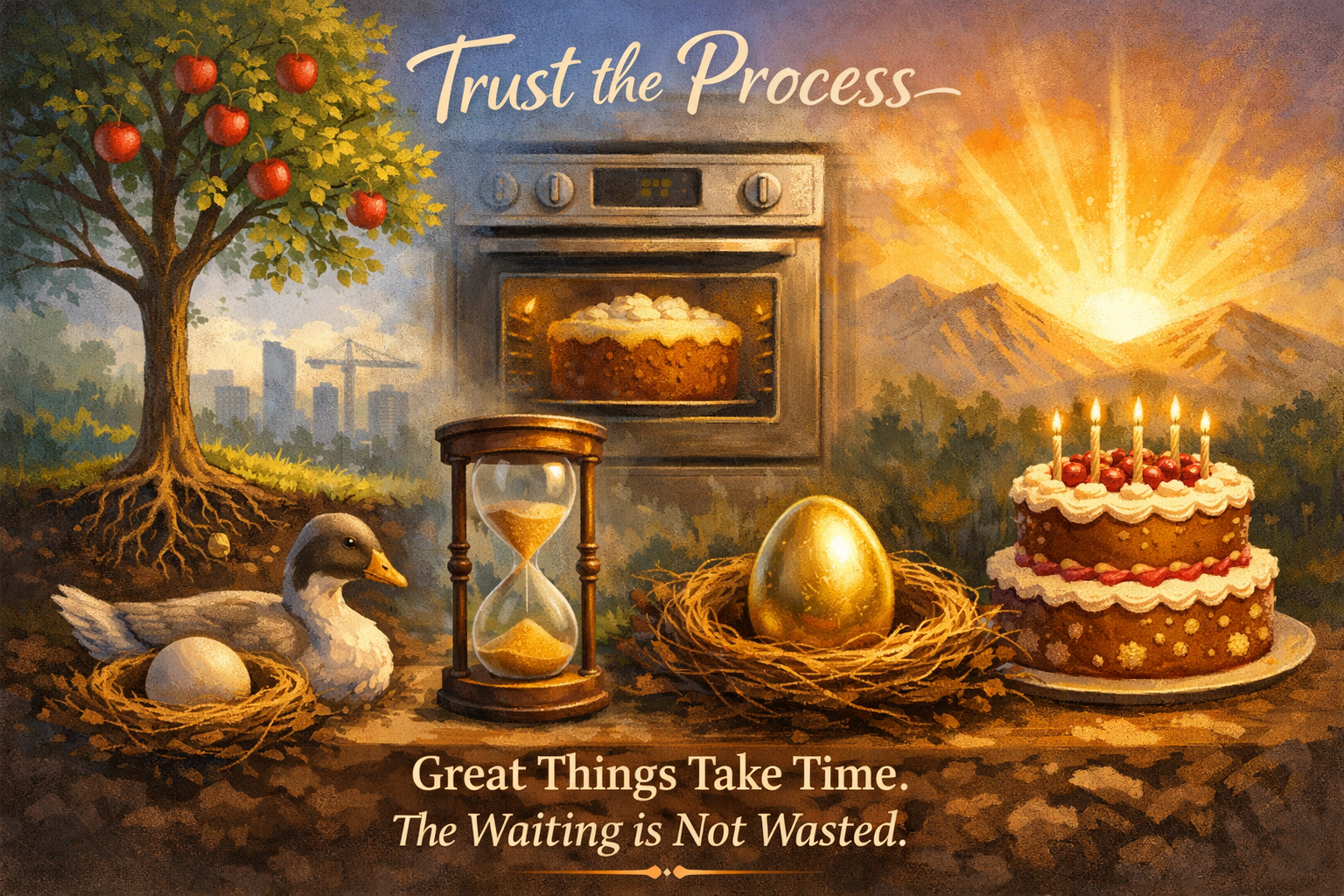
Before we can enjoy a delicious cake, we must give the ingredients time to bake. Before we can eat the fruit from a tree, we must first plant and nurture the seed—then wait as it germinates, grows, and finally bears fruit. Even before we can hold the golden egg, the goose must take time to lay it.

Everything worthwhile requires time. Food, automobiles, homes, and inventions all take a process far longer than ten seconds before they reach our hands. Yet in our age of instant gratification, we forget this basic truth: impatience can short-circuit progress.

Just as no chef can rush the oven without ruining the recipe, we can’t rush the growth phases in our own lives. Before I can handle the weight of larger projects, I must first endure the learning curves of smaller ones. Before I can lead with wisdom, I must first walk through seasons that test and refine my character.

The time it takes to reach a finished product always depends on its size or complexity. Masterpieces, whether they’re careers, relationships, or personal calling require layers of formation that only time can reveal. No wonder patience is called a virtue.

So instead of sabotaging the process with frustration, let’s rejoice in it. Because when the work is finally complete, the outcome will be far greater than we imagined. The waiting is not wasted. It’s preparation.

“Let perseverance finish its work so that you may be mature and complete, not lacking anything.” — James 1:4 (NIV)

Change Gears

In the action-packed sequel The Family Plan 2, Dan Morgan—the reformed assassin formerly known as Sean McCaffrey—takes his family to London for a surprise Christmas visit with his daughter, Nina. The festive spirit quickly evaporates when Dan’s past catches up to him in the form of his long-lost half-brother, Finn Clarke.

In one high-stakes sequence, the family finds themselves in a desperate escape. Dan’s son, Kyle, is thrust into the driver’s seat of a manual transmission vehicle. As the villains close in, Kyle realizes he’s floorboarding the gas, but the car isn’t gaining ground; it’s just screaming in high RPMs. His mother, Jessica, realizes the problem immediately. She coaches him through the mechanics of the stick shift, shouting for him to change gears. The moment he shifts, the tension releases, the tires grip, and the family rockets to a higher speed.

The Danger of the High RPM

Do you ever find yourself “redlining” in your own life? We often get caught in a maniacal focus on a specific goal or, conversely, we find ourselves stuck in a comfortable but stagnant rut. In both scenarios, we are technically “moving,” but we aren’t advancing.

If you stay in first gear while trying to maintain highway speeds, two things happen:

  1. You burn out: The engine (your mind and body) cannot sustain that level of friction forever.
  2. You lose effectiveness: You’re working harder than ever, yet you’ve hit a ceiling of momentum.

Finding Your Clutch

Unless you are willing to depress the clutch—to momentarily disengage from the “drive” of your daily grind—you cannot shift to a more effective pace. Shifting gears isn’t about stopping; it’s about adjusting your engagement with the world to achieve a better result with less mechanical strain.

For me, changing gears looks like stepping away from the screen for a walk, getting lost in a movie, or the quiet solitude of reading and creative writing. Lately, I’ve been reminded that while some “refreshers” might seem elaborate or time-consuming in the moment, they are necessary for the long game. The “pause” of the shift is what allows for the “power” of the next gear.

What’s your means of changing gears? Are you willing to step off the gas long enough to find a higher speed?

Verse for Reflection

“He makes me lie down in green pastures, he leads me beside quiet waters, he refreshes my soul.”
Psalm 23:2-3

The Quiet Work of Transformation

I’ve been working on my own transformation with more intention this year. Not the loud, dramatic kind—the kind that announces itself with fireworks and declarations—but the quieter, more honest kind. The kind that asks you to sit with yourself, confront your patterns, and choose differently even when the old ways feel easier.

And I’ll tell you the truth: change is hard. Not because we’re weak, but because we’re human.

Still, I’ve been leaning on a few voices that have helped me navigate the terrain with more clarity and courage.

Tony Robbins: Three Lenses That Reshape Reality

Tony Robbins offers a simple but profound framework—one that refuses to let us hide behind exaggeration or despair.

  • See the situation as it is, not worse than it is.
  • See the situation better than it is.
  • Make it the way you see it.

These three steps form a bridge—from honesty, to hope, to execution.

Chip and Dan Heath: The Anatomy of Change

In Switch, Chip and Dan Heath describe change as a three‑part negotiation between different parts of ourselves:

  • The logical side that wants clarity and direction.
  • The emotional side that wants meaning and motivation.
  • And the path itself, which must be simplified into the next small, doable step.

If any one of these is neglected, change stalls. If all three are aligned, change accelerates.

Where This Meets You

Maybe this resonates with you. Maybe you’re in your own season of becoming—stretching, shedding, reimagining. Or maybe you’re already standing in a place you once only dreamed of. If so, I celebrate that with you.

Either way, transformation is not a solitary pursuit. Someone you know is hungry for change, quietly wrestling with the same questions you’ve conquered or are currently confronting.

If this message speaks to you, pass it on. You never know whose life might shift because you shared a spark of insight at the right moment.

Transformation is possible.
Not easy.
Not instant.
But possible—and worth every step.

A Scriptural Anchor

“Being confident of this, that He who began a good work in you will carry it on to completion until the day of Christ Jesus.” —Philippians 1:6

This verse reminds us that transformation is a divine partnership. What begins in faith is sustained by grace—and God finishes what He starts.