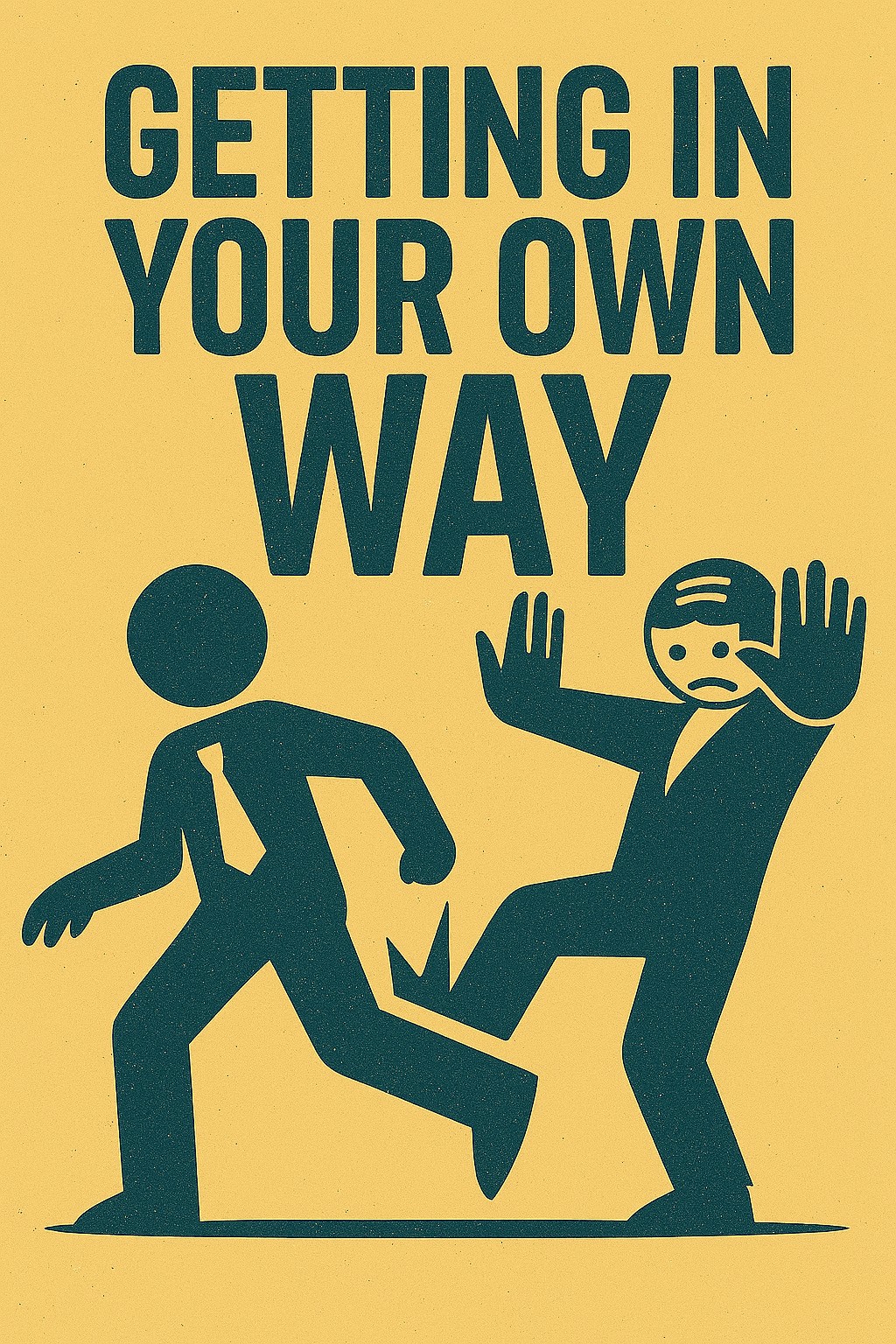
Why We Sabotage What We Want Most

Understanding the hidden psychology behind self-sabotage and reclaiming your path to growth

We’ve all been there—setting goals with clarity and conviction, only to find ourselves doing the very things that derail our progress. Whether it’s procrastinating, overspending, or avoiding the hard conversations, self-sabotage feels like a betrayal of our own intentions. But it’s not random. It’s a signal.

Here’s what’s really going on beneath the surface—and how to break the cycle.

1. Fear of Success and Change

Progress demands transformation. It asks us to shed old identities and step into new ones. But change—even good change—can feel threatening. Sabotage is often a way of clinging to the familiar.

2. Imposter Syndrome

When we don’t believe we’re worthy of the success we’re pursuing, we unconsciously act in ways that confirm that belief. It’s a self-fulfilling prophecy rooted in doubt.

3. Emotional Avoidance

Growth requires discomfort—discipline, vulnerability, effort. Sabotage is often a shortcut to avoid those feelings. It’s easier to scroll, spend, or distract than to face what’s hard.

4. Addiction to Immediate Gratification

Our brains are wired for dopamine. Quick hits of pleasure—junk food, impulse buys, social media—can override long-term goals. Sabotage often feels good in the moment, even if it costs us later.

5. Loyalty to Old Stories

Some of us carry generational or cultural narratives that glorify struggle. Sabotage can be a way of staying loyal to those stories, even when they no longer serve us.

🔄 How to Break the Pattern

  • Name the Emotion: Before you sabotage, pause. Ask: What am I feeling right now? What am I afraid of?
  • Reframe the Identity: Instead of “I always mess up,” try “I’m learning to show up differently.”
  • Create Rituals, Not Just Goals: Habits anchored in meaning are harder to sabotage.
  • Practice Compassion: Sabotage isn’t a sin—it’s a signal. Treat it with curiosity, not shame.

Self-sabotage isn’t proof of failure. It’s proof that something deeper needs healing. When you understand the roots, you can rewrite the story—and reclaim your progress.

“I do not understand what I do. For what I want to do I do not do, but what I hate I do.”

-Romans 7:15 (NIV)

Your Best for No Regrets

We’ve all been there: standing on the edge of a decision, feeling the pull to play it safe. We tell ourselves it’s a form of self-preservation, a way to avoid the sting of failure. But that path leads to a far greater pain: regret.

Giving your best isn’t just about the outcome; it’s about making a fundamental choice to leave nothing on the table. It’s a commitment to your full potential.

Our brains are wired to avoid pain. We fear the pain of trying and failing more than the slow, corrosive pain of not trying at all—until it’s too late. Regret is the psychological tax we pay for playing it safe. It’s the emotional toll of knowing we had more to give and held back. The pain of a temporary setback can become a stepping stone for growth; the pain of “what if?” is a permanent burden that erodes the spirit.

We’re Built for More

Human beings are designed with far more capacity than we realize. Most of us cruise at 40–60% of what we can actually handle. Our bodies and minds are wired to conserve energy, but that instinct works against us when it comes to pursuing greatness.

Take David Goggins, for example. He’s an ultra-marathon runner, Navy SEAL, and author who openly admits he wasn’t born with superhuman genetics. What set him apart was his refusal to settle for less than his all. He discovered what he calls the 40% rule: when you think you’re done, you’re usually only 40% done. There’s another 60% sitting untapped, waiting for you to reach for it.

Goggins’ story proves that giving your best isn’t about talent—it’s about mindset. It’s about refusing to accept the comfort zone as your ceiling. He understood that our minds give up long before our bodies do. By pushing past self-imposed limits, he found an unshakable peace that comes from knowing he gave everything he had.

What It Means for You

This isn’t abstract philosophy; it’s a profound behavioral principle. We are wired for progress, for challenges, for expansion. Our brains are incredibly plastic, and our bodies are far more capable than we give them credit for. The limiting beliefs we hold about ourselves are mostly a construct of fear. We set artificial boundaries because it feels safer than exploring our true limits.

So, what does this mean for you? “Giving your best” is your strategy for a life free of regret. It’s a conscious decision to choose the temporary discomfort of effort over the long-term ache of inaction. You have more in your tank than you think. The only way to find it is to give your all.

Start small. The next time you face a challenge, commit to giving it your absolute best effort. Don’t obsess over the outcome; focus on the effort. When you’re done, you’ll have something more valuable than any victory: the peace of mind that comes from knowing you did everything you could.

That, my friends, is worth more than gold.

“Whatever you do, do it from the heart, as something done for the Lord and not for people.” — Colossians 3:23 (CSB)

Intentional Action

Humans communicate, accomplish, and advance by design. We express intentions through action. At a social gathering, we extend a hand and offer a smile. We don’t wait for others to guess our warmth—we show it. We don’t hope people understand us—we reveal ourselves.

When we face an exam, we study. We review notes. We solve problems. We prepare. We don’t rely on potential—we prove our knowledge through effort. When we aim to become better speakers, we practice. We deliver speeches. We observe great communicators. We don’t just wish for improvement—we earn it.

We move forward only when we act. We don’t drift toward goals—we steer toward them. We don’t stumble into growth—we build it.

🧭 Columbus: A Man Who Moved

Christopher Columbus didn’t discover new lands by standing still. He sailed. He persuaded monarchs. He assembled crews. He launched ships. He endured storms. He navigated uncertainty. He didn’t wait for perfect conditions—he created opportunity through motion.

Columbus didn’t reach Asia, but he reached the Caribbean. He didn’t fulfill his original plan, but he changed history. He acted with intention. He moved with purpose. He didn’t theorize—he explored.

His ships—the Niña, the Pinta, and the Santa María—didn’t symbolize dreams. They embodied action. They didn’t drift—they cut through oceans. Columbus didn’t wait for the world to change—he changed it by moving.

🔥 Movement Builds Meaning

We don’t achieve by thinking alone—we achieve by doing. We don’t grow by hoping—we grow by working. We don’t transform by imagining—we transform by engaging.

We must act. We must move. We must perform. Every step we take brings us closer to our destination. Every effort we make shapes our future.

Let us raise our sails. Let us leave the shore. Let us move toward the horizon.

“But be doers of the word and not hearers only, deceiving yourselves.”
—James 1:22 (CSB)

4 Quarters

The Comeback Story

It was a chilly December evening, and the stadium was packed with fans, their breath visible in the cold air. The New England Patriots were facing the Atlanta Falcons in Super Bowl LI. By the end of the third quarter, the Patriots were down 28-9. The odds seemed insurmountable, and many had already written them off. But in the fourth quarter, something incredible happened. Tom Brady, with his unyielding determination, led the Patriots to score 19 points, tying the game and forcing it into overtime. The Patriots went on to win 34-28, completing one of the greatest comebacks in NFL history.

The Metaphor: A Day In 4 Quarters

Just like a football game, our day can be divided into four quarters. Each quarter represents a part of our day: morning, late morning, afternoon, and evening. Often, we judge our entire day based on how the first few quarters go. If the morning starts off rough, we might feel like the whole day is doomed. If the late morning and afternoon don’t go as planned, we might be tempted to give up, thinking the day is a lost cause.

The Fourth Quarter: A Chance to Win

But just like the Patriots in Super Bowl LI, we have a fourth quarter. No matter how the first three quarters of our day have gone, the fourth quarter is an opportunity to turn things around. It’s a chance to persist, to push through, and to make the most of the time we have left. The fourth quarter is a reminder that it’s never too late to make a comeback.

That project you’ve been putting off? You can start it in the fourth quarter. That relationship you’ve neglected? You can send the text or make the call in the fourth quarter. That workout you skipped this morning? You can still move your body before bed.

Champions aren’t just defined by how they start—they’re remembered for how they finish.

Don’t write off the day. Don’t bench yourself when there’s still game left to play. Dig deep. Adjust your strategy. Persist. Win your fourth quarter.

Persist and Win

Life is full of challenges and setbacks, but it’s also full of opportunities for comebacks. When we find ourselves down and out, we can look to the fourth quarter as a time to regroup, refocus, and push forward with renewed determination. Remember, it’s not over until it’s over. Keep fighting, keep believing, and keep pushing forward.

Scripture for Encouragement

“Let us not get tired of doing good, for we will reap at the proper time if we don’t give up.”

—Galatians 6:9 (CSB)

Let’s embrace the fourth quarter with the same determination and hope, knowing that we have the power to turn things around and finish strong.