Have you ever noticed how your journey seems different from everyone else’s? While some sail smoothly on highways, you may feel like you’re trekking a winding mountain trail. And sometimes, that difference sparks admiration… or irritation… or even envy.
But here’s the truth: your path is not supposed to look like theirs. It’s designed for you. Your mission, destiny, personality, and life experiences shape the route you’re meant to take.
Think about it: Jesus’ mission was salvation for the world—His path was the cross. A doctor’s mission is to heal, and their path is years of medical school and residency, sometimes over a decade of intense preparation.
Every worthwhile path has its challenges. The question isn’t whether someone else’s journey looks easier or more glamorous. The real question is: are you willing to walk the road they had to walk to reach their success?
Instead of envy, let’s choose admiration. Instead of comparison, let’s choose respect. And instead of resentment, let’s choose celebration.
Because the best way to honor your own path is to walk it with focus, faith, and perseverance—knowing it was created with you in mind.
“Let us run with endurance the race that lies before us, keeping our eyes on Jesus, the pioneer and perfecter of our faith.” — Hebrews 12:1–2 (CSB)
We all want the breakthrough without the breakdown. The progress without the process. But life, in its stubborn wisdom, doesn’t allow shortcuts. It requires us to walk through the very thing we’d rather skip.
The challenge is patience. Time is a teacher that refuses to be rushed. And when you’re in a season of recovery or growth, time feels like a treadmill set on “eternity mode.” Every step counts, but it seems like you’re not moving fast enough.
Here’s the real question: What am I recovering from, and what am I progressing toward?
The answer determines the length and intensity of the process. Some wounds heal quickly while others require layers of restoration. Some goals are sprints; others are marathons. Either way, rushing only leads to reinjury or burnout.
Take Steve Young’s story, for example. Long before he became a Hall of Fame quarterback, he spent years sitting on the bench behind Joe Montana. It would have been easy to get frustrated, to think he’d never get his shot. But instead, he worked tirelessly in practice—studying, refining, and preparing. The process was long, humbling, and sometimes painful. Yet when his moment finally came, he wasn’t just ready—he excelled. His Super Bowl victory and MVP awards were the fruit of years of unseen work.
That’s why it’s crucial not to get frustrated with the processing of the process. The delays, the repetitions, the slow unfolding—it’s all part of shaping you for what’s next. God isn’t simply fixing circumstances; He’s refining character.
So, when impatience whispers, “Hurry up,” remember that every slow moment has meaning. Healing has its own pace. Growth has its own rhythm. And both are preparing you for what you prayed for.
As Paul reminds us:
“Being confident of this, that he who began a good work in you will carry it on to completion until the day of Christ Jesus.” —Philippians 1:6 (CSB)
For years, I thought progress—whether in marriage, personal growth, or work—required daily consistency. If it wasn’t happening every single day, I felt like I was falling short. But life’s schedule had other ideas.
The turning point came during a marriage planning exercise. My original plan was to connect with my spouse daily, but our calendars didn’t agree. Rather than forcing what wasn’t working, we shifted our sessions to Sundays—and it worked beautifully. That one change revealed something bigger: I already had a natural weekly flow.
Daily Foundation: The 3 Cs Every morning, I start with a routine I call the 3 Cs:
Center – Water, writing, and Bible reading, along with prayer and exercise, to ground my mind and spirit.
Consume – Fuel my body with something light to energize for the day ahead.
Conquer – Launch into a mindset ready to win the day, tackling tasks with focus and intention.
This daily foundation sets the tone for the week and supports each of the 4 R’s.
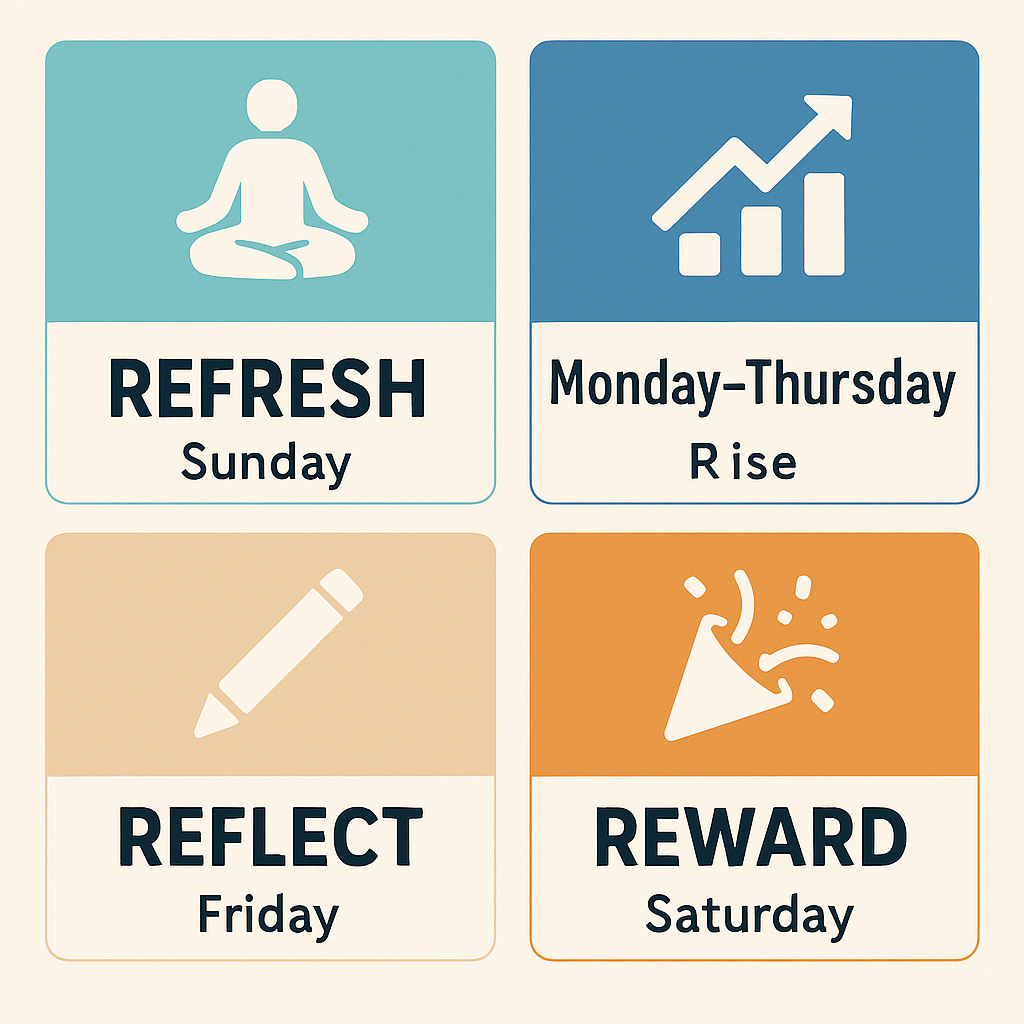
Here’s how my weekly rhythm looks:
Sunday – Refresh (Marriage & Myself) 🧘 Sunday is sacred for renewal. It’s when I attend church, intentionally connect with my spouse, and carve out time for my own restoration—whether that’s reading, or simply quiet moments. This day is about refilling my cup so I can pour into the week ahead.
Monday–Thursday – Rise (Productivity & Progress) 📈 These are my “go” days. Fueled by Sunday’s reset, I commit to moving projects forward, tackling work goals, and leaning into growth. Momentum happens here—personally, professionally, and relationally. These are the days I intentionally rise to the challenge.
Friday – Reflect (Pause & Take Stock) ✍️ Friday is for intentional assessment. It’s my chance to look back—what went well, what needs growth, where I need to give thanks. Sometimes that’s journaling, sometimes it’s a walk or a good conversation. Reflection clears the way for Saturday.
Saturday – Reward (Celebrate the Wins) 🎉 By Saturday, it’s time to enjoy the fruit of the week—whether that’s a date night, a favorite meal, or simply something fun. Reward keeps the joy alive and marks a healthy close to the week. It’s a purposeful celebration.
Riding the Wave
What I’ve learned is this: daily checklists can feel rigid, but weekly rhythms flex with life’s realities—work, appointments, shifting energy, and the unexpected. Instead of fighting the tide, I’ve learned to ride the wave.
Your rhythm doesn’t need to look like mine. The point is not perfection but sustainability: creating a cadence that allows you to refresh, rise, reflect, and reward in ways that bring balance and growth.
“There is a time for everything, and a season for every activity under the heavens.” — Ecclesiastes 3:1 (CSB)
Ray Charles, the legendary musician whose soulful voice and piano mastery transcended generations, was not born blind. As a child, he loved the piano so much that the moment he heard his neighbor, Wylie Pitman, playing, he would rush over just to listen. Even before he could properly play, he would bang his hands on the keys in delight. Pitman, seeing the spark in the boy’s heart, began to teach him the basics.
Ray eventually lost his sight—initially thought to be a psychological condition, later diagnosed as glaucoma. Yet, blindness did not blind his ambition. Though he could not see, he could hear. And through hearing, he built melodies that moved millions. His eyes were closed, but his vision was open.
This leads us to a deeper truth about perception. If you look at the world through blue lenses, you will see blue—no matter how many voices insist it is red. Similarly, in life, there are moments when what we see and what we hear do not match. Psychologists call this “audiovisual incongruence.” In human experience, it manifests as confusion, indecision, and inconsistency. We cannot walk a straight path when our eyes and ears tell conflicting stories.
But here’s the real challenge: You don’t perceive the world as it is—you perceive it as you are. Our biases, wounds, and beliefs tint the lenses through which we see and filter the sounds we hear. If the lenses are bitter, the world will look bitter; if the soundtrack in our minds is fearful, the world will sound threatening.
So if we wish to experience the world as a better place, we must first become better people. We must align what we see with what we hear, rooting both in truth, humility, and love. Only then will our perception match reality, and only then will we walk with consistency of vision and clarity of direction.
“The eye is the lamp of the body. If your eye is healthy, your whole body will be full of light.” — Matthew 6:22, CSB
Before I reveal how I completed that sentence, let’s take a moment to reflect. Bob Marley once said, “Life without music, I can’t cope.” For him, life was musical—something to be felt deeply, rhythmically, and soulfully.
Maybe you’ve heard or even lived by some of these perspectives:
Life is a pain.
Life is an adventure.
Life is a test.
Life is a game.
Life is worthwhile.
Life is a blessing.
Life is not worth living.
Life is worth living.
Life is worthless.
Each of these reflects the heart and the mindset of the one speaking. They speak to where someone is mentally, emotionally, or spiritually at a given moment. And let’s be honest—sometimes we’ve felt all of them in the same week!
But here’s my definition:
Life is a blessing.
Yes, it can feel like a test on Monday, a game on Tuesday, and a rollercoaster by Wednesday. But even in the chaos, I’ve learned that life is either preparing me, teaching me, or rewarding me. Every challenge becomes a classroom. Every joy, a celebration. Every detour, a divine rerouting. And every silence, a setup for something greater.
Seeing life as a blessing doesn’t mean we ignore pain or pretend trials don’t exist. It means we choose to believe that something good can come out of everything—even the mess.
So when life feels like a test, I remember it’s a blessing in disguise. When it feels like a game, I’m learning strategy, patience, and how to bounce back. When it feels like an adventure, I lean in and trust the Guide.
Life is a blessing because it constantly invites us to grow, reflect, and give thanks. Not because it’s easy—but because it’s meaningful.
📖 “Give thanks in everything; for this is God’s will for you in Christ Jesus.” — 1 Thessalonians 5:18 (Christian Standard Bible – CSB)





 ThoughtPager