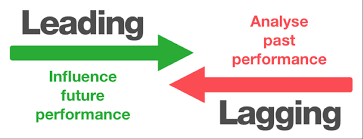
Leading and Lagging

In Finance and Economics, there are inputs called leading and lagging indicators. Leading indicators occur before the big result or event and lagging indicators occur after.

Leading indicators show what is on the horizon and require appropriate inputs to be made up front to get there. Some examples of leading indicators for an entrepreneur would be,

  • How many contacts are made to prospects daily.
  • What percentage of follow-ups are made after first attempts?

On the other hand, lagging indicators are measurable outputs. So, using the same entrepreneur example, lagging indicators would show,

  • How many of the prospects contacted made a purchase.
  • How much new or repeat business was generated from follow-ups.

At times we tend to be looking for lagging indicators before committing the appropriate amount of energy or grit required for our leading indicators. For married couples, leading indicators can be,

  • Consistently spending quality time spent with each other.
  • Regularly doing acts of service for each other.

Lagging indicator examples then may be,

  • Your spouse shows love by buying an item you desire.
  • Your spouse takes the children and encourages you to spend a recreational day as you please.
  • Or, well you get the picture.

For those who are learning a new skill, leading indicators can be,

  • Practicing consistently.
  • Regularly getting good rest to help retain what you learned.

Lagging indicators may be,

  • Executing the skill with little to no mistakes.
  • Being able to effectively teach somebody else.

We all have areas where we want a particular result but need to improve our smart and consistent efforts. The multiple examples were to drive home this point.

Our challenge this week is to create or improve one leading indicator. We have done it to accomplish something significant before. So let us do it again. If you said, “I’ve not achieved anything significant yet,” you are in for a treat! God can provide you the capacity you think you are lacking to follow through.

The Lord is my strength and my defense; he has become my salvation. He is my God, and I will praise him, my father’s God, and I will exalt him.

(NIV, Exodus 15:2)

Be Glad!

I was glad when they said to me, “Let us go to the house of the Lord.”

(NLT, Psalm 122:1)

Why do we go to a church building anyway? After all the bible advocates that people form the church.

Now I say to you that you are Peter (which means ‘rock’), and upon this rock I will build my church, and all the powers of hell will not conquer it.

(NLT, Matthew 16:18)

However, the building is a neutral place for like-minded people. The first Christians did not have a building, so they met in homes. Today, although some churches may start in homes as well, they become too small to accommodate all attendees when there is extensive growth. There is something unifying, inspiring and supportive about having people with the same mind in the same place.

Whether the purpose is for religion, sports, or a movement, a meeting place provides tangible as well as intangible benefits to everyone. The most expensive religious building is the Masjid Al-Haran located in Mecca, Saudi Arabia, costing $100 billion. The SoFi stadium, which is home to the Los Angeles Rams and Los Angeles Chargers is the most expensive NFL stadium in the country, costing $4.9 billion to build. With such large amounts of money spent on these types of buildings, there is clearly significant value in believers and enthusiasts gathering in the same place.

Even though a building can be a designated place for everyone to meet, there must be a unifying purpose. An estimated 250,000 people attended the “March on Washington for Jobs and Freedom” on August 28, 1963. There is where Dr. Martin Luther King Jr. gave his “I have a Dream” speech. People traveled from all over the country for the event. Because of the cause, no matter the distance, even without a building, they were glad to gather.

Today I offer a tribute to those of you who stand for Christ and gladly gather with others to worship Him.

Happiness!

As a child attending Sunday School one of the songs, we sang went like this,

Happiness is, to know the Savior

Living a life, within His favor

Having a change, in my behavior

Happiness is the Lord

A practice of evangelicals is an “alter call” after the sermon. Non-believers are invited to accept Jesus as their Lord and Savior. From the moment of acceptance, they become a new person.

For if a man belongs to Christ, he is a new person. The old life is gone. New life has begun.

NLV, 2 Corinthians 5:17

Because new habits take time to form and old ones to eliminate, there may be a tendency to still have old thoughts after inviting Jesus into their lives. Fortunately, as a new person we have the inclination to choose new actions.

During my reflection on Friday, I was reminded that life is about people. True, some may enjoy solitude, but they still need the company of a special few.

If according to the song, “Happiness is the Lord,” a source of our happiness is people. In The Happiness Advantage, Shawn Achor noted a study that sought to find the characteristics of the happiest ten percent. The one distinguishing trait was the strength of their social relationships.

Let us continue then to include key people, especially when things are not going as they should. Let us also continue to celebrate those meaningful individuals in our lives. Who knows, we may need to make a new friend. If you do not have Jesus as a friend, I recommend him. Having Him will boost your happiness.

One who has unreliable friends soon comes to ruin, but there is a friend who sticks closer than a brother.

NIV, Proverbs 18:24

Seasons

Last week in North Texas there was an ice storm. Power was affected for some, many businesses closed for days, and there were even traffic fatalities. It reminded me somewhat of the COVID pandemic when people were confined to their homes, and nothing was opened. We wondered when it was going to turn around. Then the season began to change. In North Texas now, the temperature is warmer, the ice melted, and businesses reopened.

There is a time for everything, and a season for every activity under the heavens.

Ecclesiastes 3:1

This says to me that the season that you are going through will change. Sometimes we make incorrect long-term decisions based on a temporary feeling or season we are experiencing. It is no wonder we are cautioned to not go to the grocery when we are hungry or make important decisions when we are tired. The consequences can and typically outlive the current season.

Another thing to consider during our present juncture is what and when we plant in anticipation of our upcoming harvest season. Before harvesting, a farmer must plant seeds weeks before the crop is ready. The type of crop he wants determines how far in advance he must plant and how he cares for the seed. Similarly, for us to improve the probability of producing the crop we want in our next season we must be intentional about planting the appropriate seeds today. Imagine yourself harvesting the crop you desire in your next season, plant the seeds and nurture them daily.

But remember the lord your God, for it is he who gives you the ability to produce wealth, and so confirms his covenant, which he swore to your ancestors as it is today.

Deuteronomy 8:18