
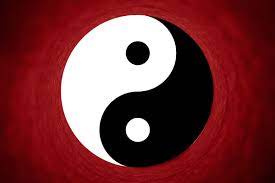
According to WorldHistory.org, “the principle of Yin and Yang is that all things exist as inseparable and contradictory opposites, for example, female-male, dark-light and old-young.”
The Internet Encyclopedia of Philosophy, mentioned that the earliest Chinese characters for yin and yang were found in inscriptions made on “oracle bones.” In these inscriptions, yin and yang simply describe natural phenomena like weather conditions, especially the movement of the sun. “There is sunlight during the day (yang) and a lack of sunlight at night (yin).”
According to the earliest comprehensive dictionary of Chinese characters, yin refers to “a closed door, darkness and the south bank of a river and the north side of a mountain.” Yang refers to “height, brightness and the south side of a mountain.” These meanings of yin and yang originated in the daily life experience of the early Chinese. Peasants depended on sunlight for lighting and their daily life routines. When the sun came out, they would go to the field to work; when the sun went down, they would return home to rest. This sun-based daily pattern evidently led to a conceptual claim: yang is movement and yin is rest.
Two of my takeaways from this study was everything is interconnected with an opposite and, there is a time for one to shine and the other to be in the shadow.
The bible teaches that there is a time for everything. So, when you find yourself in a cloudy season tempted to believe that things will not change or to give in to despair, do not. Conversely, when things are going well and you are tempted to think that your future success is inevitable, prepare for and “protect the downside,” as Sir Richard Branson said.
Let us strive to be aware of the time of day we are in and be disciplined enough to act like we know that the night follows the day, and the day follows the night.
Ecclesiastes 3:1-8 says,
To everything there is a season,
and a time to every purpose under the heaven:
A time to be born, a time to die;
a time to plant, and a time to pluck up that which is planted;
A time to kill, and a time to heal;
a time to break down, and a time to build up;
A time to weep, and a time to laugh;
a time to mourn, and a time to dance;
A time to cast away stones, and a time to gather stones together;
a time to embrace, and a time to refrain from embracing;
A time to get, and a time to lose;
a time to keep, and a time to cast away;
A time to rend, and a time to sew;
a time to keep silence, and a time to speak;
A time to love, and a time to hate;
A time of war, and a time of peace.
 ThoughtPager
Thanks for the interesting history lesson…Great thoughts! Thanks for sharing!